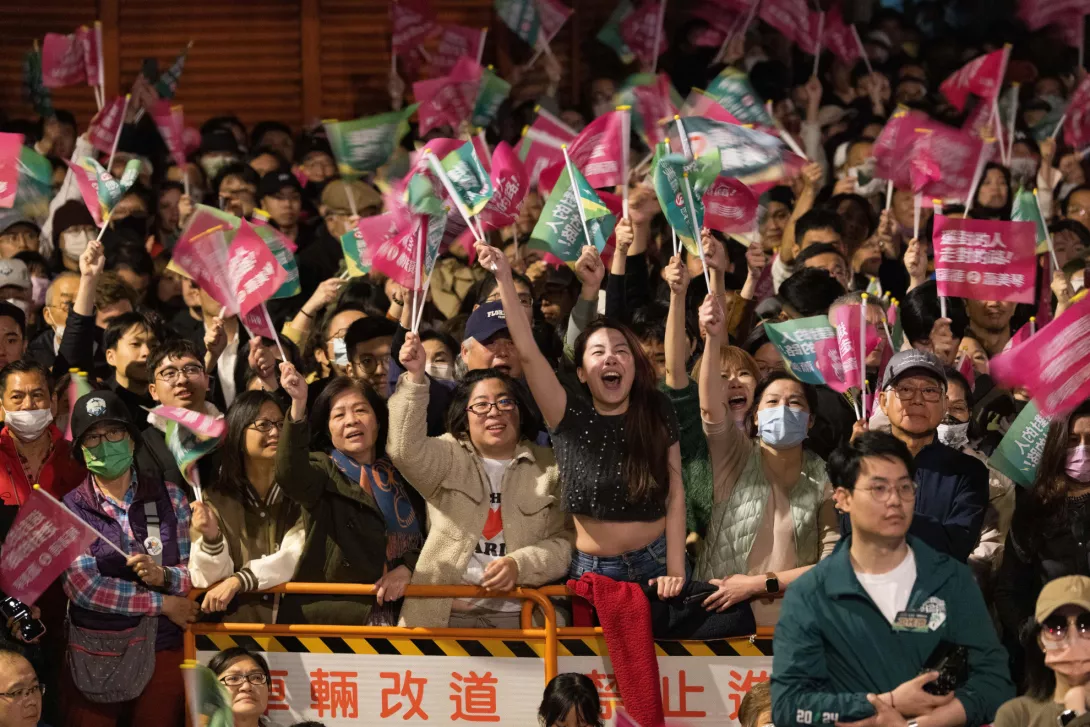
- Taiwan stands at the center of the global struggle between democracy and authoritarianism, demonstrating that a free society can resist coercion and defend its democratic future.
- Taiwan's democratic resilience offers important lessons for the Indo-Pacific, particularly in countering the Chinese Communist Party's political influence, disinformation, and coercive tactics.
- The future of Taiwan is inseparable from the future of freedom itself: Taiwan's success strengthens the global democratic order, while its failure would embolden authoritarianism across the region and beyond.
Countries that do not respect the rights of their citizens at home are far more likely to conduct aggression against other nations. Russia's onslaught against Ukraine parallels its intensifying crackdown on its own people. Iran exports terrorist violence across the Middle East while brutally suppressing its citizens. China pairs economic coercion with military threats against Japan, the Philippines, and Taiwan. Yet the balance of power still favors freedom. From Ukraine to Israel, frontline democracies are pushing back against revisionist autocracies. Taiwan, Asia's key frontline democracy, is central to the free world's future, standing as proof that a free society can resist authoritarian coercion and shape its own democratic destiny.
As Taiwan celebrates 30 years of direct presidential elections, we should remember a simple truth: its democracy was not inevitable. Taiwan's prosperity and freedom were hard-won, built through sustained effort and sacrifice that dismantled entrenched authoritarian rule. This story of generational struggle against tyranny has unfolded, in different forms, across much of the world.
In the early 1980s, most people lived under authoritarian regimes. That began to change when citizens across the world organized, protested, and pushed for greater freedoms. The United States, under President Ronald Reagan, together with its allies, reinforced these efforts by making the advancement of democratic freedoms a core pillar of foreign policy. Institutions like the International Republican Institute (IRI), founded in 1983, were created to help "foster the infrastructure of democracy" worldwide. This convergence of forces—local freedom fighters alongside political and economic pressure from the United States and Europe against authoritarian regimes—helped drive a historic wave of democratization. By the turn of the century, more than half the world lived under democratic rule.
This history matters for three reasons.
First, it provides perspective. Today's threats to freedom occur on more fronts than ever before. Authoritarian forces like the Chinese Communist Party (CCP) deploy economic leverage, invasive technologies, and malign political influence to undermine democratic governance and reshape the global system in favor of authoritarianism. Still, democracies today are more numerous, more prosperous, and better equipped than at freedom's low point during the Cold War. They possess critical soft-power tools and decades of experience advancing democracy and supporting others in its defense.
Second, this history underscores that freedom is not self-sustaining. It requires strategy. As authoritarian regimes are actively exporting their models and coordinating their efforts, democracies must do the same. Open societies must work together to strengthen institutions, support political actors, and defend the rules that underpin freedom. This is no longer a task for a small group of Western democracies. Our response must build on the strengths of the many capable democracies worldwide. Taiwan, as a frontline democracy in Asia, should be central to this effort.
Third, it shows that change can happen unexpectedly. Even seemingly stable authoritarian regimes can collapse suddenly. Lack of visible progress does not mean democracy advocates are failing; rather, it signals the need to double down and persist. Democracy promotion is a test of endurance.
This is a winnable fight—no people anywhere craves corrupt and tyrannical rule over self-government grounded in individual rights and freedoms. Still, some argue for retreat, suggesting we go back to the pre-Reagan era of democracies focusing inward and abandon efforts to advance freedom globally. That approach misreads both history and reality. It assumes democracies are overextended when they have never been more prosperous relative to the rest of the world. It also gives authoritarians far too much credit, overestimating their strength while downplaying the internal fragilities that could precipitate their collapse.
At the same time, we must recognize that our playbook must evolve. We are most effective in our campaign for freedom when we mobilize the full universe of democratic actors, each contributing their unique strengths. At IRI, we understand democracy as an ongoing, locally practiced project within a connected global ecosystem—its success or failure affects us all. The most relevant innovations in governance, transparency, and resilience are no longer confined to the United States or Europe; they emerge wherever democracy is practiced, and often most clearly on the frontlines. That is why IRI has built deep partnerships and a presence across every region, including in Taiwan.
Too often, Taiwan is viewed narrowly through the lens of semiconductors or geopolitical risk. While its importance in the global technology supply chain is undeniable, and war in the Taiwan Strait would be catastrophic, this framing understates Taiwan's deeper significance to the future of freedom.
Democracy, especially Taiwan's democracy, threatens the CCP. In every Asia-Pacific country where IRI works, Beijing seeks to undermine transparency, capture elites, weaken institutions, and erode sovereignty. When democracy is fragile, these efforts gain traction. Where rule of law is strong and governance transparent, they falter. Competitive politics, vibrant civil society, and effective democratic institutions are the best defenses against China's coercion.
The CCP's malign influence is the greatest single threat to democracy in Asia. Yet many countries are confronting it in isolation, developing responses in silos without the legal tools or full visibility into the scale of the problem. Taiwan, however, has already faced and successfully countered many of these threats.
Often described as the testing ground for China's influence operations, Taiwan has experienced the full spectrum of CCP tactics—propaganda, social media manipulation, sowing discord in the information space, coercion of businesses, and harassment of elected officials—earlier and more aggressively than anywhere else in the region.
Despite Beijing's multi-pronged attacks, Taiwan's democracy doesn't merely persist; it thrives. Consistently ranked the freest country in Asia, Taiwan has become a proving ground for democratic resilience. That resilience is no accident. It owes to proactive government action, strong partnerships with civil society, and a steadfast commitment to transparency, press freedom, and the rule of law—all of which enable effective government and civil society responses.
Taiwan's lessons are increasingly shaping resilience strategies across the region. At IRI engagements in Asia, Taiwanese civil society representatives have shared systems for tracking when local officials and journalists are wined-and-dined in Beijing, and political party members have discussed their experiences with CCP-aligned propaganda during electoral campaigns. These exchanges are not theoretical; they are driving real collaboration and equipping partners across Asia to better detect and resist China's malign influence.
Taiwan's experience demonstrates a broader point: democracy, when functioning well, is not vulnerable; it is adaptive. It can learn, respond, and grow stronger under pressure. Taiwan's significance also extends beyond policy. It is symbolic. Across the world, millions living under authoritarian rule continue to demand dignity and freedom. From Burma to Iran to Venezuela, the desire for liberty endures despite repression, and Taiwan stands as proof that such aspirations can succeed.
Taiwan's path was neither linear nor guaranteed. It required political courage, institutional reform, and sustained public commitment. In a single generation, Taiwan went from decades of authoritarian rule to becoming one of Asia's freest and wealthiest societies, while facing unrelenting pressure from the world's most powerful autocratic state. This shows that democracy is not merely a set of laws or elections, but a driver of stability, prosperity, and human dignity. It also shows that authoritarian alternatives are neither inevitable nor superior.
The stakes are clear. If Taiwan's democracy endures, it reinforces a regional and global future where freedom can thrive. If Taiwan succumbs to authoritarian aggression, the balance of power in Asia would tilt toward tyranny. IRI's work with Taiwan, therefore, extends beyond advancing critical U.S. security and economic interests. It reflects America's commitment to preserving the principle that people can govern themselves and chart their own destinies.
That principle remains the foundation of a freer, more stable world.