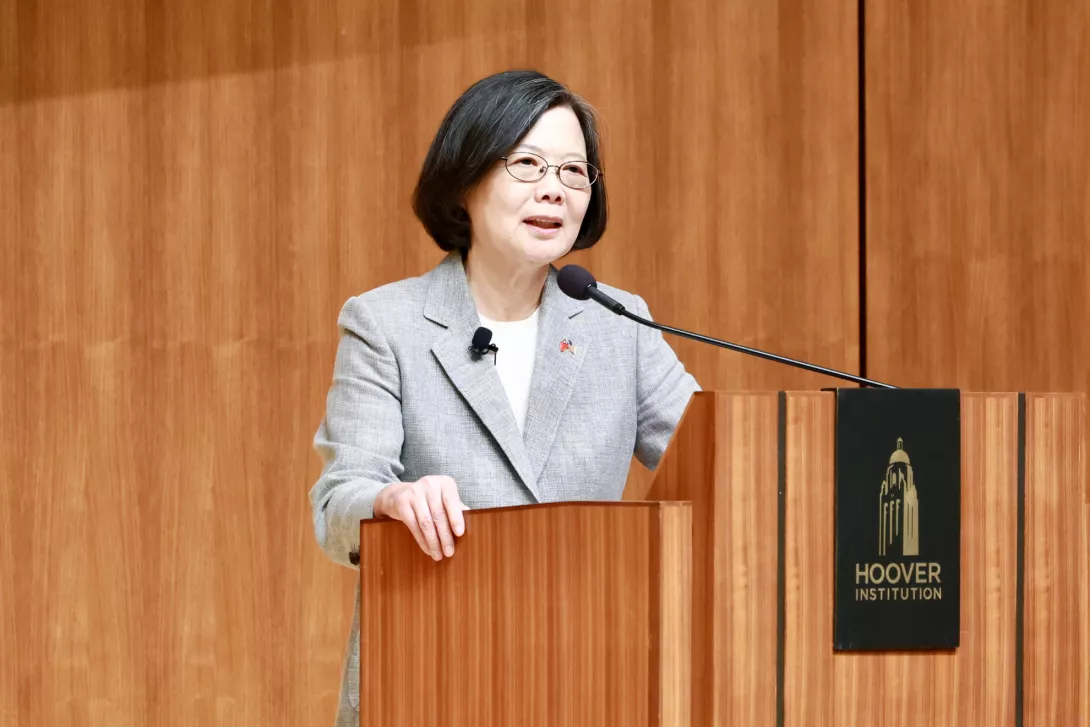
Speaking at Stanford University's Hoover Institution, former President Tsai Ing-wen reflects on Taiwan's democratic journey and how decades of political and social challenges have shaped its resilience. She examines the pressures facing democracies today, draws lessons from Taiwan's experience in democratic governance, and highlights what Taiwan can contribute to strengthening international cooperation and democratic resilience worldwide.
It is a great honor to join you here at Stanford University's Hoover Institution.
I want to begin by thanking Professor Larry Diamond and Admiral James Ellis, for the invitation to speak here, and for the opportunity to be among so many distinguished scholars, experts, policymakers, and students.
I must say that universities have always had a special place in my heart. I started my career as an academic, and some of the best years of my life were spent at university as a professor.
Being on a university campus always brings back fond memories. It also reminds me why I believe so strongly that universities help shape our future leaders.
That same commitment to learning, reflection, and preparing future generations has been part of the Hoover Institution's history since its founding after the First World War. This makes the Hoover Institution a fitting place to reflect on the challenges democracies face today, what history can teach us, and how our societies can work together to build a more peaceful and resilient future.
Taiwan Beyond the Headlines
When people talk about Taiwan, the conversation usually centers around semiconductors, the AI revolution, our relationship with China, the possibility of conflict and, ok, maybe sometimes bubble tea and soup dumplings.
These subjects are important and they do matter. But, beyond the sensational headlines, are twenty-three million people who have built a democracy under far more difficult circumstances than most nations have had to face. That experience has shaped who we are and continues to shape how we approach the future.
Over the years in politics, including when I was president, some people have described me as "boring." I have never been particularly offended by that, and I promise I will try not to prove them right with this speech today.
But, in a time when politics is increasingly polarized and provocation often attracts more attention than restraint, being a little boring may actually be useful, especially when your responsibility is to keep Taiwan secure, and find enough common ground for a democracy to keep moving forward.
Democracy under Pressure
Democracies today are being tested from both outside and within. Authoritarian influence from outside is becoming more sophisticated and aggressive, while internal populism and polarization make it harder for democratic societies to agree on how to respond, even when the external threat is clear.
This development has a certain amount of relevance, to the increasing use of the internet as a communication and information tool.
Not so long ago, we believed that the internet could strengthen democracy by expanding communication, information, and participation. But we have since learned that connecting people is not the same as helping them agree.
The internet lowered the cost of communication, but it did not lower the cost for building shared understanding. In some cases, it actually made consensus harder by spreading divisive rhetoric even faster than information that brings people together.
We made a similar assumption about globalization, believing that greater economic integration would broaden prosperity and in turn, reinforce democratic stability. But when the benefits were distributed unevenly, economic and social divisions became an increasingly powerful source of political grievance and populist discontent.
Populism often grows out of accumulated grievances, including economic insecurity, rapid social change, and a growing sense, that democratic institutions no longer respond to ordinary citizens' needs.
When these grievances are left unanswered, they can become fertile ground for political extremism. Democratic institutions, therefore, have to demonstrate, through effective governance, that they can still respond to people's concerns and improve their lives, even when doing so requires politically difficult decisions.
Moreover, advances in artificial intelligence also contribute to the intensification of social division by lowering language barriers, making it easier to conduct information manipulation campaigns across societies or countries. Ill-intentioned actors, especially from outside, use social media platforms to spread false and misleading information to drive a wedge between fellow citizens, between societies and their governments, and even between countries.
Polarization has made it harder for democracies to act together when unity is most needed. Our adversaries understand this. And they use disinformation and other forms of influence to deepen divisions and weaken institutions.
As democratic backsliding spreads, authoritarian governments have become more confident in their ability to adapt, cooperate with one another, pursue expansionist agendas, and interfere in democratic societies.
One lesson from Taiwan's experience is that democratic resilience depends, among other things, on the ability to preserve a sense of commonality.
I learned this from my legal training, which taught me not only to identify differences, but also to look for what people have in common.
Democracy gives us the freedom to disagree, sometimes profoundly. But when societies become deeply polarized, we also have to ask what we still share.
And finding that commonality does not mean erasing political differences, or expecting everyone to hold the same view. It means preserving enough shared understanding, that disagreement does not make collective action impossible.
This is where Taiwan has something meaningful to contribute.
Decades of living with external pressure and intense domestic political competition have taught us how to protect our democracy, while keeping our institutions open and our society resilient. Elections in Taiwan can be fiercely contested, and political disagreements do not disappear once the votes are counted. But there is a fundamental line for all of us - that is our democracy.
After an election, people return to their respective roles, institutions continue to function, and despite our differences, we find ways to work together when important issues affecting the country must be addressed. This experience has given Taiwan practical lessons in democratic resilience that we can share with other democracies confronting similar pressures today.
Resilient Taiwan
Democracies are sometimes noisy and chaotic, but the important thing is, when needed, people would make efforts to create a collective force, or be prepared to be flexible to form consensus. To deal with their collective challenges, be it domestic or from the outside, you may call it democratic resilience.
Taiwan knows what resilience requires, because our democracy was built through a long process of adjustment, negotiation, and collective efforts. For decades, political reforms were restricted, and people were imprisoned for dissent. Yet, Taiwan was able to move from authoritarian rule to its first direct presidential election in 1996, and over time, to the vibrant democracy it is today. That transition taught us how to confront deep political differences without allowing those differences to make democratic progress impossible.
That experience continues to shape how Taiwan responds to pressure. Democratic resilience develops gradually. Each difficult issue tests whether institutions can function, citizens can participate, and society can find enough common ground to move forward. Over time, successfully managing these challenges strengthens confidence in democratic institutions.
During my presidency, that is from 2016 to 2024, Taiwan also strengthened resilience on several fronts. Defense spending increased by more than 80 percent while GDP grew by almost 40 percent, and we invested more heavily in asymmetric capabilities and critical infrastructure.
And my successor President Lai continues to strengthen our defense capacity and economic and social resilience, particularly by establishing the All-out Defense Mobilization Agency to strengthen reserve training and whole-of-society preparedness.
At the same time, Taiwan expanded its defenses against cyber threats and information manipulation, working closely with civil society, and international partners to counter disinformation and foreign influence.
Taiwan has also worked to reduce excessive dependence on any single market or supply chain, while building stronger partnerships with like-minded economies. Our high-tech industries, especially semiconductors, are central to global supply chains and the continued development of artificial intelligence.
Like every democracy, Taiwan has its own divisions and difficult debates.
At the same time, we live with frequent natural disasters and a constant external threat, which have given Taiwanese society a strong sense, that there are moments when we must put our differences aside and come together. And each time Taiwan successfully confronts one of these challenges, our society becomes more resilient and more confident in its ability to respond to the next.
Adaptation in Practice: Democracy in Action
That resilience has been built through the way Taiwan has handled difficult and often contentious issues as a democracy.
In the past, Taiwan has faced deeply divisive issues, involving pension reform, marriage equality, mandatory military service, crisis management in our response to the pandemic, and relations with China.
These issues generated real disagreements, and in some cases considerable political and societal resistance. But our resolve has generally been to work through those disagreements within democratic institutions, rather than allow them to paralyze our country.
One of the most politically difficult decisions we made was the reform of the pension system for public employees, as the system was becoming financially unsustainable. The process was costly, but consultation, explanation, and adjustment allowed us to move forward on a problem that could no longer be postponed.
Marriage equality divided Taiwanese society in a very different way. Yet, after the Constitutional Court's ruling, the government was able to turn a deeply contested social issue into legislation through democratic processes and a massive campaign of debates and communications among the general public. Taiwan, thus became the first in Asia to legalize same-sex marriage.
National defense posed another difficult test. Extending mandatory military service and increasing defense investments required the public to accept greater costs in response to a changing security environment, while still holding the government accountable for those decisions.
The COVID-19 pandemic tested another set of national capacities. Taiwan drew directly on lessons from the SARS outbreak in 2003, and moved early to strengthen its border and public-health measures, and relied heavily on transparent communication and digital tools.
The social trust we built meant the government could ask people to cooperate and exercise restraint, because citizens had access to information, (e.g. daily press conferences to provide updated information as well as answer sometimes difficult questions from the public), as a matter of transparency exercise: and the public then could scrutinize what their government was doing. Crisis management in a democracy depends on whether society has enough confidence in its institutions to act collectively.
Managing relations with China have required the same combination of preparedness and restraint. Decades of facing pressure from China have made Taiwan more resilient and pragmatic. The people in Taiwan may differ as to how the eventual relationship with China should be structured; however, we have built a consensus in maintaining the cross-Strait status quo, avoiding unnecessary provocation, and at the same time, making clear that Taiwan would protect its democracy and security.
Restraint should not be mistaken for weakness; its purpose is to prevent miscalculation, while giving Taiwan the space to strengthen itself and preserve peace.
These experiences are very different, but they reflect a common approach. Resilience comes from the ability to respond to change, absorb political and social pressure, and make difficult adjustments without abandoning democratic processes or allowing disagreement to paralyze the country.
All these issues are very different, but together, they reveal something important about Taiwan's democratic resilience. It has been built through repeated experience in confronting disagreement, making difficult adjustments, and finding ways to move forward collectively. Taiwanese politics can be intensely competitive, and our disagreements can sometimes be very dramatic and loud. But there is also a deeply rooted understanding that we share the responsibility for resolving the problems that affect all of us.
This comes from Taiwan's history and experience. We live with earthquakes, typhoons, public health emergencies, and the continuing external threat to our democracy. These experiences have created a common understanding that there are moments when political differences have to give way to collective action. We saw this during the COVID-19 pandemic, and we see it repeatedly after natural disasters, when people who may disagree strongly about politics immediately come together to help one another. In 2025, tens of thousands of people turned out to help the recovery, after a major natural disaster in the eastern part of Taiwan, presenting one of the best examples of that collectivity.
This is why I remain confident in Taiwan's ability to deal with the challenges ahead. Our society has weathered difficult tests before, and each successful response has added another layer to our resilience.
The world is now presenting democracies with deeper and more complicated challenges, from polarization and information manipulation, to economic insecurity and external coercion. Taiwan is not immune from them. But our experience gives me confidence that Taiwanese society will continue to argue, adjust, and ultimately find ways to address these challenges together, just as we have done before. And the lessons we accumulated through that process are not only important for Taiwan; they are increasingly relevant to other democracies facing many of the same pressures.
What Taiwan Can Contribute
Discussion of Taiwan often begins with the question of why Taiwan matters. Equally important, however, is what Taiwan can contribute to the democratic community.
That contribution goes beyond semiconductors and technology. Our experience has taught us how to protect elections, maintain public trust, and build cooperation between government and civil society.
We do not offer a perfect model, but many of the challenges we have faced are now shared by other democracies. Cyberattacks, disinformation, supply-chain disruptions, and pressure on ones democracy can also create wider consequences for regional stability and the global economy.
Working with Taiwan, therefore, is not simply helping Taiwan. It is also about strengthening a broader system of peace, trade, technology, and democratic cooperation.
Taiwan is ready to be part of this collective effort, as a partner with experience, capabilities, and lessons to contribute.
Conclusion
We are living through a profound transition in the global order, one in which longstanding assumptions are being tested and remade. Amid this uncertainty, one thing should be clear: democracy, resilience, and partnership are the foundation of our collective future. And no amount of threat or coercion will shake Taiwan's determination to engage and contribute to the world.
Taiwan does not want to be known only for the dangers, or the external threats it faces. It should also be known for the society its people have built. Over the years, no matter how difficult the challenges or how deep our differences, we have understood that we still share a responsibility to find common ground, and work toward solutions together. That same belief guided me when I was serving as president.
Perhaps that did make me a little "boring." But sometimes restraint, patience, and the willingness to look for the common ground beneath our differences are exactly what leadership requires.
I want to end by thanking the Hoover Institution again for hosting this talk. And to all of you for taking the time to be here.
Taiwan is home to many excellent universities. I hope when some of you decide to study and conduct research abroad, you will consider coming to Taiwan. Come meet our people, try our delicious food, and see our democracy in action for yourselves.
Thank you very much.
Speech delivered at the Hoover Institution on October 8, 2026. Founded in 1919 by Herbert Hoover, who later became the 31st U.S. president, the Hoover Institution is a public policy research center at Stanford University focused on national security, economic policy, democratic governance, and global affairs.