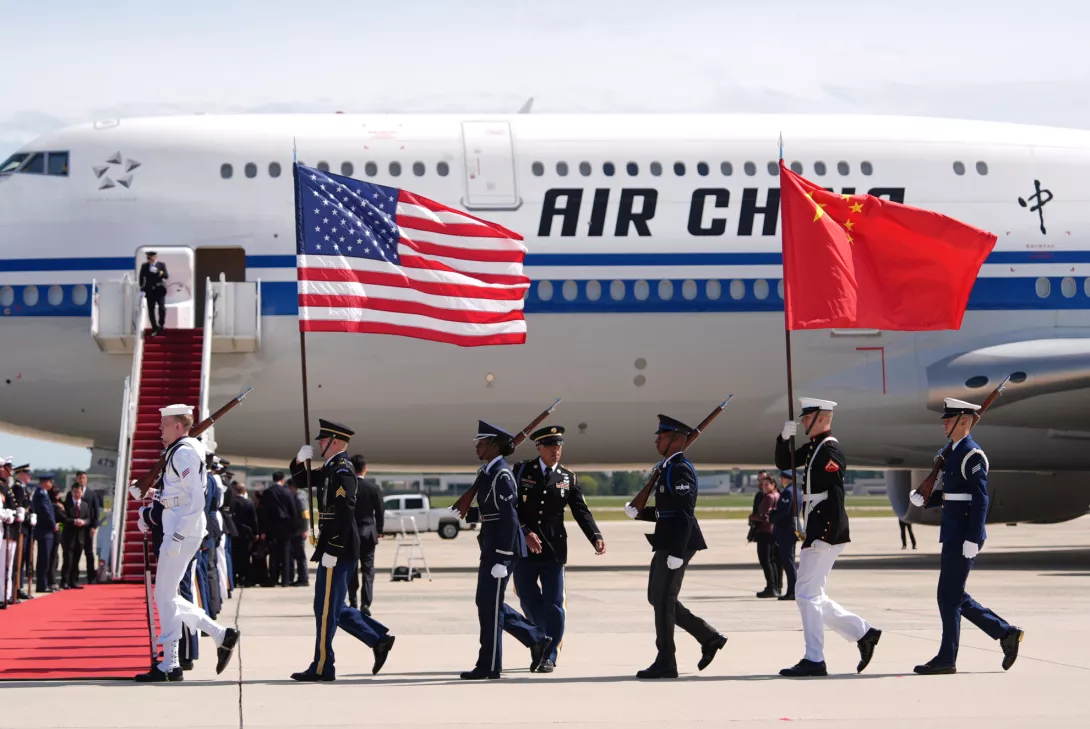
- During the Trump-Xi meeting, Beijing renewed pressure on Washington to shift from “not supporting” to actively “opposing” Taiwan independence.
- Trump’s emphasis on U.S.-China economic relations underscores the importance of sustaining arms sales and defense cooperation with Taiwan.
- The future of U.S.-Taiwan relations will depend on actions, particularly continued arms sales, military cooperation, and political engagement.
U.S. President Donald Trump hosted People’s Republic of China leader Xi Jinping at the White House for the leaders’ second meeting of 2026. This summit focused on building progress on the various economic and trade deals and negotiations from the Beijing summit, which occurred in May 2026. Given various controversies and fears related to artificial intelligence, Washington and Beijing addressed that issue, establishing the U.S.-China Super Intelligence (SI) Dialogue. Before the summit began, U.S. Treasury Secretary Scott Bessent and PRC Vice Premier He Lifeng agreed to create an AI hotline to notify the other side of breakouts, hacks, and other negative actions. Overall, the summit lacked significant intrigue and controversy despite much speculation about what the two leaders would agree to.
Given Trump’s comments after the conclusion of the Beijing summit, which I analyzed previously for the Thinking Taiwan Foundation, there was a fear that Trump would further derail U.S.-Taiwan relations or spark a new controversy by signing on to Xi’s perspective of cross-Strait relations. Granted, the public documents make little mention of Taiwan. In fact, the White House’s fact sheet does not even mention Taiwan; it is only a PRC Ministry of Foreign Affairs press release that addresses what the two leaders discussed on Taiwan. The two governments’ readouts are quite different, with each side emphasizing or omitting key points.
This article seeks to analyze the implications of the second Trump-Xi summit for the future of U.S.-Taiwan relations. It will first recap the controversial remarks about Taiwan made by Trump after the Beijing summit; then, it will evaluate what occurred at the Washington summit. The article will conclude by providing expectations for what the short-term future of U.S.-Taiwan relations will be for the duration of 2026 and through the end of the Trump administration.
Recapping the Beijing Summit: Trump’s Taiwan Confusion
At the first Trump-Xi summit of 2026, Taiwan played a much more publicly central—and confusing—role. Xi elevated Taiwan to serve as the defining issue of the U.S.-China relationship when he “stressed that the Taiwan question is the most important issue in China-U.S. relations. If it is handled properly, the bilateral relationship will enjoy overall stability. Otherwise, the two countries will have clashes and even conflicts, putting the entire relationship in great jeopardy. ‘Taiwan independence’ and cross-Strait peace are as irreconcilable as fire and water. Safeguarding peace and stability across the Taiwan Strait is the biggest common denominator between China and the U.S. The U.S. side must exercise extra caution in handling the Taiwan question.” That characterization set the tone for how Xi expected Trump to accommodate Beijing’s position on cross-Strait relations. And only Washington would be to blame for it not being “handled properly.” Only a properly handled U.S. Taiwan policy would allow Washington and Beijing to improve their tense relationship.
While Trump apparently did not engage Xi on the Taiwan issue during the summit, he did throw multiple wrenches into the conversation on his way home from Beijing. After reportedly telling Xi “I don’t talk about that” when pressed about Taiwan, Trump then had much to say about Taiwan on Air Force One. He said that he would “be making decisions” on arms sales to Taiwan, which he called a “very good negotiating chip.” Trump also confirmed that he violated the longstanding Six Assurances by discussing arms sales with Xi, arguing, “What am I going to say? I don't want to talk to you about it, because I have an agreement that was signed in 1982?” He also promised to speak to President Lai Ching-te.
Since the May summit in Beijing, there has been little movement on these issues. Trump has not formally canceled or approved the pending arms package. To the public’s knowledge, Trump has not called Lai. Everything remained undetermined, and conversations would likely continue at the next summit in Washington.
The Washington Summit: Taiwan Independence on the Table?
Based on the first summit’s Taiwan fireworks and leaks about Xi’s plans to press Trump on Taiwan in Washington, Taiwan would certainly be a major factor for the success or failure of the summit. The noise surrounding the summit made it seem like someone would budge on Taiwan, and that someone was likely going to be Trump given his skeptical comments about Taiwan immediately after the Beijing summit. But it wasn’t.
As mentioned, only one publicly released document mentioned Taiwan. According to the PRC press release, “President Xi stressed that the Chinese side’s position on safeguarding national reunification and territorial integrity is clear-cut. It is hoped that the U.S. side will adhere to the correct position of opposing ‘Taiwan independence,’ and handle the Taiwan question with caution, so as to lay a solid foundation for China-U.S. strategic cooperation and the development of bilateral relations.” Xi’s remarks to Trump clarify the evolving PRC position on how the United States should approach Taiwan moving forward, with subtle implications. The statement also implied that Trump may already abide by some of China’s position on Taiwan—even though such nuance may have been lost on Trump.
The U.S. position of “not supporting” Taiwan independence is no longer acceptable in Beijing. For the U.S.-China relationship to move forward, Washington must “oppose” such a move. While subtle, there is a clear difference between “not supporting” something and “opposing” something. By not supporting Taiwan independence, Washington can take two tracks: advise Taipei against ever pursuing such a path or do nothing to facilitate such a move. Opposing Taiwan independence would box Washington into taking proactive steps to prevent Taipei from taking a more active role in countering PRC aggression.
In Beijing’s interpretation, opposing Taiwan independence does not mean actively lobbying Taipei to stop an independence referendum. It means stopping Taiwan from implementing its own national security strategy to counter ever-increasing PRC coercion. It means banning all U.S. arms sales to Taiwan. It means preventing U.S. officials—governors, mayors, members of Congress, administration staff—from visiting Taiwan and explicitly supporting Taipei. It means sending home some of the American “English teachers” advising Taiwan’s military. It is not a difference in rhetorical flair; it is a complete change in U.S. policy and abrogation of the Taiwan Relations Act. Anything short of these actions would run counter to Xi’s view on opposing Taiwan independence.
While Xi’s statement was not as explicit as his remarks in Beijing, he still directly tied the success of U.S.-China relations to the tenor of U.S.-Taiwan relations. The hoped-for “solid foundation” between Washington and Beijing cannot exist without the Trump administration opposing Taiwan independence. Xi’s views provide Beijing with an easy out for any issues that it seeks to back away from by using U.S. support for Taiwan as the reason.
It seems like the next evolution of this configuration will be tying the U.S. refusal to oppose Taiwan independence to preventing Beijing from “safeguarding national reunification and territorial integrity.” That is, Washington is working against China’s territorial integrity.
After this summit concluded, more information surfaced on what was discussed about Taiwan. Trump merely said of Taiwan, “Right now, it’s fine. It’s just moving along.” Trump claimed that Taiwan was not a major topic of discussion since both leaders know where the other stands. One major difference between the two summits is that Trump had less downtime after the Washington summit. After the Beijing summit, he had a long plane ride home to publicly process Xi’s talking points and cause immense confusion. In Washington, Trump simply moved on to the next thing, and had less-than-normal access to the U.S. press corps due to the boycott in response to Trump’s pulling of credentials of three media outlets.
Trump, according to U.S. Ambassador to China David Perdue, also offered to sell U.S. arms to China. Such a sale would be illegal, and the U.S. Congress would not approve such a sale. Trump and Xi also talked about arms sales to Taiwan, according to Perdue, but apparently in the context of how Washington sells arms to countries around the globe. The ambassador also clarified that the U.S. position and policy on Taiwan has not changed: “We don’t support independence, and we don’t support coercion.”
What to Expect in the Final Months of 2026
Trump and Xi are likely to meet two more times before the end of 2026: at the APEC summit in Shenzhen and at the G20 summit in Miami. Assuming those two leader-to-leader meetings go off without a hitch, Trump and Xi will have met face-to-face four times in one calendar year. Those face-to-face meetings are key for Taiwan: as long as Trump is expecting to meet with Xi, the pending arms sale package will be delayed.
Beijing set a clear red line: formal authorization of the currently pending arms sale package to Taiwan will result in the postponement or cancellation of the next scheduled meeting between the two leaders. That threat was dangled before the Beijing summit, and again before the Washington summit. And based on the fact that the package, which Congress already blessed, has been sitting with Trump for most of 2026, it is safe to assume that he will not approve the package until the next two meetings occur—at the earliest. It is also safe to assume that as long as Beijing meets its trade commitments in the so-called “truce,” then Trump will continue to delay final approval of the package.
Trump has made a U.S.-China economic deal a priority since his first term, and this time, it comes with a real cost: stalling future arms packages to Taiwan. He can use the depleted munitions stockpiles caused by the Iran war as a reason for delaying them, but such a rationale falls flat when he approves arms sales to other countries.
Beyond the indefinite pause in arms sales to Taiwan, it is unlikely that the Trump administration will formally announce that the United States opposes Taiwan independence. Support for Taiwan is a rare foreign policy position that both Democrats and Republicans share. U.S. Taiwan policy is safe between now and early November because Trump will be focused on not losing Republican majorities in the House and Senate. After that, when the APEC and G20 summits take place, it is doubtful that Taiwan policy will be at the forefront of his mind.
Arms sales are unlikely to be approved in 2026, and a major change to Taiwan policy is also not likely.
Until the End? U.S.-Taiwan Relations until January 2029
Taiwan has survived major hits after the two-marquee U.S.-China summits in 2026. However, if Trump delays the pending arms package well into 2027, then Taipei will begin to feel the hit: it will lose months, perhaps years, before acquiring much-needed systems and munitions, and the skepticism about U.S. support for Taiwan under Trump will continue to increase. Each time that Trump meets Xi between now and the end of his second term, Taipei will wait with bated breath to see what possible policy changes or rhetorical confusion Trump creates.
Officially, the Trump administration has not changed U.S. Taiwan policy. We do not know what Trump has told Xi in private about his views on Taiwan. We do know that Xi allegedly promised Trump that he would not invade Taiwan as long as Trump is president. That expectation could box in Xi since Trump might view any military action against, or blockade of, Taiwan as an affront to their personal relationship. However, from the outside, it appears as though Trump and Xi share the same belief that Taiwan needs to stop acting out, which pushes Beijing to act in response. This assessment could be wrong, but Xi’s remarks on opposing Taiwan independence imply that the two have the same mindset on the topic.
Beyond the arms issue, there are clearer signs of Trump’s views on Taiwan that would ring alarm bells if they occurred. Delaying an arms package is a public display of waffling. However, on the ground, the United States still supports Taiwan and the development of its military and national security. If the Trump administration were to stop lower-level officials from visiting Taiwan for meetings and dialogues, halt military cooperation, cease publicly condemning PRC coercive actions, or pull more U.S. troops from Japan or South Korea, then Taipei would have a real reason to worry about the next couple of years.
Even then, any Taiwan-related policy changes are only temporary. After Trump leaves office in 2029, the next U.S. president will have a different mindset on China, and likely Taiwan, and one that aligns more closely with U.S. public opinion.