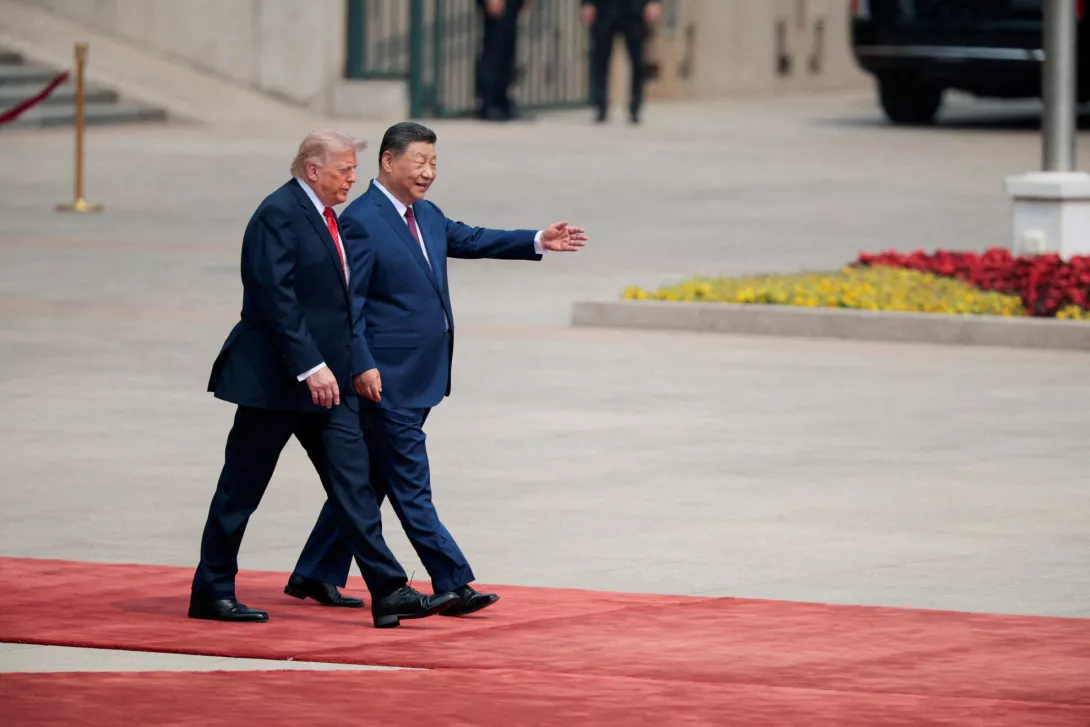
- The Trump–Xi summit revealed how Beijing increasingly seeks to place Taiwan at the center of the broader U.S.–China relationship, framing stability in bilateral ties as contingent upon Washington's handling of Taiwan.
- Although no formal policy shift emerged from the summit itself, President Trump's post-summit comments injected new uncertainty into U.S.–Taiwan relations, particularly regarding arms sales and long-standing American strategic commitments.
- The episode underscores a broader concern for Taiwan and the Indo-Pacific: even without an official policy reversal, unpredictability and transactional diplomacy can erode confidence in the reliability of U.S. security commitments.
On May 13–15, People's Republic of China leader Xi Jinping hosted U.S. President Donald Trump for a state visit in Beijing. The summit, originally scheduled for April 2026, was postponed by Washington because of the Iran war. That conflict, along with the closure of the Strait of Hormuz, altered the broader geopolitical backdrop of the Trump–Xi meeting as global energy prices surged. Yet one issue remained unchanged: Beijing's position on Taiwan and its expectation that Trump would make concessions to accommodate China on what it considers its most important strategic issue.
Ahead of the summit, analysts and media outlets published a wave of commentary speculating that a major shift in U.S. Taiwan policy might be imminent. Xi was expected to press Trump on Taiwan, while Trump—viewed as a transactional "dealmaker"—was widely seen as potentially willing to exchange concessions on Taiwan for progress on trade. With the summit now concluded and few concrete deliverables announced, the most positive outcome may simply have been that the meeting occurred and that both leaders exchanged views directly. The real uncertainty now lies in how Trump's post-summit remarks, which cast doubt on U.S. support for Taiwan, may ultimately translate into policy.
Attempt to Redefine Terms of U.S.-China Relations
The narrative leading up to the summit created ample space for Beijing's position on Taiwan to dominate coverage in the U.S. media. The assumption that Trump was likely to alter U.S. policy carried an unstated implication: that Washington should accommodate Beijing's demands on Taiwan. Xi capitalized on this atmosphere by recalibrating Taiwan's place within the broader U.S.-China relationship.
Xi opened the high-stakes summit with a clear signal that he expected movement on Taiwan. He framed the future trajectory of U.S.-China relations as fundamentally dependent on the Taiwan issue. According to the PRC's official readout, "President Xi stressed that the Taiwan question is the most important issue in China-U.S. relations. If it is handled properly, the bilateral relationship will enjoy overall stability. Otherwise, the two countries will have clashes and even conflicts, putting the entire relationship in great jeopardy. 'Taiwan independence' and cross-Strait peace are as irreconcilable as fire and water. Safeguarding peace and stability across the Taiwan Strait is the biggest common denominator between China and the U.S. The U.S. side must exercise extra caution in handling the Taiwan question."
Given Beijing's expectations for progress on Taiwan during the summit, it was unsurprising that Xi chose to begin with such a warning. It established the tone he hoped would guide the broader discussions. At least during the opening remarks, Trump did not take the bait. "In the meeting, Trump did not respond to Xi's comments about Taiwan and moved on to the next topic without acknowledging them at all." Even so, Trump later acknowledged that the two leaders discussed Taiwan extensively.
What matters most about Xi's opening remarks is the extent to which he elevated Taiwan to the central issue in U.S.-China relations. He publicly tied the stability of bilateral ties to Washington's future handling of Taiwan. In many ways, this framing is consistent with Beijing's behavior in recent years. China canceled eight bilateral dialogues and joint initiatives in 2022 following then-U.S. House Speaker Nancy Pelosi's visit to Taipei. Beijing has sanctioned U.S. politicians for supporting Taiwan, targeted defense contractors involved in arms sales, and temporarily suspended communication with U.S. defense officials in response to Taiwan-related engagement. Xi's remarks place the burden entirely on Washington: from Beijing's perspective, it is U.S. support for Taiwan that has destabilized the relationship. In this narrative, meaningful progress on bilateral issues is impossible as long as Washington continues its current approach. Notably absent from Xi's framing is any acknowledgment of China's own coercive behavior toward Taiwan. In Xi's telling, only the United States possesses agency.
Allowing that framework to take hold would be a serious mistake, as it would imply that Washington must operate within Beijing's terms on Taiwan in order to preserve broader bilateral stability. Trump and his team must ensure that China does not dictate the parameters of American foreign policy. Judging from Trump's subsequent remarks on Fox News, it appears that Xi's message resonated with him.
Post-Summit Policy Changes
In Xi's presence and with cameras rolling, Trump avoided making any dramatic or off-the-cuff statements on Taiwan of the sort for which he is often known. During the summit itself, no clear policy changes regarding Taiwan emerged. Secretary of State Marco Rubio, a long-time supporter of Taiwan during his years in the U.S. Senate, summarized the administration's position succinctly: "U.S. policy on the issue of Taiwan is unchanged as of today."
That reassurance held only until Trump returned to speaking with the American media after leaving Beijing. His comments deepened preexisting skepticism and confusion regarding both his support for Taiwan and his willingness to approve a major arms package.
When asked about defending Taiwan, Trump stated candidly, "That question was asked to me today by President Xi. I said I don't talk about that." In one sense, this reflects Trump's own version of longstanding U.S. strategic ambiguity regarding whether and under what circumstances the United States would intervene militarily in the event of a Chinese attack on Taiwan.
Trump has long shown a tendency to echo talking points from counterparts, even from those that are non-democratic, after high-level meetings, and the Beijing summit proved no exception. The key question is how long Xi's framing will continue to shape Trump's thinking before either advisers intervene or Beijing itself changes the dynamic.
More concerning were Trump's remarks regarding future arms sales to Taiwan. While departing Beijing, he stated that he would "be making decisions" on future arms sales to Taiwan, which had reportedly been discussed "in great detail." He also characterized U.S. arms sales as "a very good negotiating chip" in relation to Taiwan. Such discussions cut against the spirit of the Reagan-era "Six Assurances," under which Washington pledged not to set an end date for arms sales to Taiwan and not to consult Beijing about such sales.
Trump, never one to defer to traditional foreign policy conventions, dismissed those concerns when pressed further, asking rhetorically, "What am I going to say? I don't want to talk to you about it, because I have an agreement that was signed in 1982?" The broader spirit of the Six Assurances endured for more than four decades, but Trump's willingness to discuss these issues directly with Xi marked a significant departure. Ending arms sales altogether could also conflict with the Taiwan Relations Act, which states that U.S. policy includes providing Taiwan with arms of a defensive character. Presidents from both parties—including Trump himself during his first term, when Taiwan received record levels of U.S. arms sales—maintained that policy.
Presidents George W. Bush and Barack Obama both temporarily paused arms sales to Taiwan in an effort to stabilize relations with Beijing, but neither consulted China on those decisions, nor did either administration end the practice altogether. Trump would become the first president to openly treat arms sales to Taiwan as leverage in negotiations with Beijing.
What Trump is now publicly entertaining is unprecedented and stands in sharp contrast to President Joe Biden's repeated statements during his administration affirming that the United States had a commitment to defend Taiwan against Chinese aggression.
Ironically, while ending arms sales might satisfy Beijing, Trump's manner of handling the issue could still irritate Xi. Trump stated that he would need to speak with "the person who... is running Taiwan" before making any final decision on arms sales. Days later, he reiterated his desire to speak directly with President Lai Ching-te. On May 20, Trump remarked, "I'll speak to him... I speak to everybody. We have that situation very well in hand... we'll work on that Taiwan problem." What initially appeared to be a casual remark increasingly seems to reflect a serious intention.
If Trump follows through, it could undermine whatever progress was achieved elsewhere during the summit. Beijing reacted sharply after Trump spoke by phone with then-President Tsai Ing-wen following his 2016 election victory. Trump would again become the first U.S. president to publicly acknowledge direct communication with Taiwan's president, something Beijing has long sought to prevent since the Carter administration severed formal diplomatic ties. However, if the ultimate outcome were reduced arms sales, Beijing might decide the tradeoff is worth tolerating. Taipei, meanwhile, would likely seek to influence Trump through economic inducements, particularly semiconductor investment in the United States. Still, Lai faces the disadvantage of dealing with a U.S. president who has often displayed sympathy for authoritarian strongmen over smaller democratic partners.
Trump's interview with Fox News' Bret Baier touched on nearly every major Taiwan-related point of contention. What Trump may have viewed as strategic ambiguity or tactical flexibility instead reinforced fears that he could ultimately abandon Taiwan. Asked whether Taiwan should feel more secure after the summit, Trump replied simply, "Neutral. This has been going on for years." He also repeated his long-standing criticism that Taiwanese semiconductor manufacturing should move to the United States.
At the same time, Trump stopped short of explicitly opposing Taiwan independence. "I'm not looking to have somebody go independent," he said, adding, "But we're not looking to have somebody say, 'Let's go independent because the United States is backing us.'" In reality, there is currently no serious movement within Taiwan pushing formal independence, which should undercut Beijing's efforts to portray the issue as imminent. The source of cross-Strait tension lies less in U.S. support for Taiwan than in Beijing's insistence that Taipei accept its political formula for unification.
Trump's eventual decision on whether to approve, delay, or downgrade arms sales to Taiwan may prove to be the clearest indicator of where he ultimately stands within the U.S.-Taiwan-China triangle. Xi did not secure a public commitment in Beijing to end arms sales, but his arguments clearly seem to linger in Trump's thinking. In the short term, Xi may already have achieved an important objective: sowing confusion and distrust regarding U.S. support for Taiwan. Still, it remains doubtful that Trump would completely terminate arms sales to a democratic partner purchasing U.S. weapons at full cost, particularly given bipartisan congressional pressure to approve the next package.
What's Next for the U.S.-Taiwan Relationship?
The summit and Trump's post-summit comments have not fundamentally altered Taiwan's immediate strategic position. Before the summit, uncertainty surrounded what Trump might change. After the summit, that same uncertainty persists. In that sense, little has changed: Trump remains deeply unpredictable. The world will learn more about the trajectory of U.S. Taiwan policy only when Trump makes a final decision on the pending arms package.
Trump's remarks may simply be an attempt to extract concessions from both Taipei and Beijing. In the sensitive cross-Strait environment, comments that deviate from decades of carefully calibrated policy language can weaken the credibility of the United States not only in Taiwan but throughout the Indo-Pacific and beyond. Unlike most countries, the United States has codified aspects of its Taiwan policy into law. If Trump ultimately approves the latest arms package, this episode may eventually be remembered as a temporary disruption. But even then, skepticism is unlikely to disappear as long as Trump remains president. And whoever succeeds him may face the difficult task of rebuilding trust not only in Taiwan but across the wider region.
Congress, meanwhile, has begun increasing pressure on Trump not to abandon decades of support for Taiwan. Bipartisan letters are only one part of that effort. Republicans and Democrats alike have voiced strong support for Taiwan following the Beijing summit. Representative Michael McCaul argued that Washington must "arm Taiwan so they can defend themselves for deterrence against Chairman Xi." Representatives Gregory Meeks and Brian Fitzpatrick echoed similar sentiments. Even House Speaker Mike Johnson stated, "Our position on Taiwan, they need to stay independent and secure there." Senator Lindsey Graham has also indicated plans to introduce sanctions legislation targeting China in the event of an invasion of Taiwan.
This bipartisan congressional support remains crucial to the long-term durability of the U.S.-Taiwan relationship. Presidents and policies may change, but congressional backing has historically endured. Yet on the issue of arms sales, ultimate authority still rests with the president, which is precisely why Trump's unprecedented rhetoric and behavior have generated such alarm.
Despite the uncertainty, Taipei has sought to project confidence while continuing to cultivate Trump's support. Taiwan's Ministry of Foreign Affairs publicly expressed gratitude for Trump's longstanding backing of Taiwan. "The United States has repeatedly stressed that its long-standing policy toward Taiwan remains unchanged. This position has been reaffirmed by President Donald Trump... We are grateful for President Trump's continued support for cross-strait security since his first term, including announcements of weapons sales that have reached record highs."
Trump' unpredictability—and his pending decision on arms sales—has pushed U.S.-Taiwan relations into unfamiliar territory. When Bush and Obama paused arms sales, they did so quietly, and Taipei retained confidence that broader relations would eventually stabilize. Under Trump, that certainty has eroded. If Trump declines to approve the congressionally supported arms package, there is no guarantee that sales would resume later. What distinguishes Trump's second term from his first is a noticeably greater willingness to accommodate Beijing, with a potentially diminished U.S.-Taiwan relationship emerging as one consequence.
At the same time, this is hardly the first occasion on which Trump has wavered in his support for U.S. allies and partners before later changing course under pressure from advisers or Congress. Pro-Taiwan lawmakers will likely need to play an active role in shaping Trump's ultimate decisions and mitigating the damage already done. Regardless of what Trump ultimately decides regarding Taiwan, members of Congress now face an even greater responsibility to demonstrate bipartisan support through sustained engagement with Taipei.
Although formal U.S. policy toward Taiwan has not yet changed, perceptions of the United States as a reliable security partner have clearly been shaken. Taiwan may weather this latest post-summit storm, but Trump and Xi are expected to meet again later in 2026. The U.S.-Taiwan relationship has survived difficult periods before, but regular Trump-Xi meetings may push the relationship into new territory.