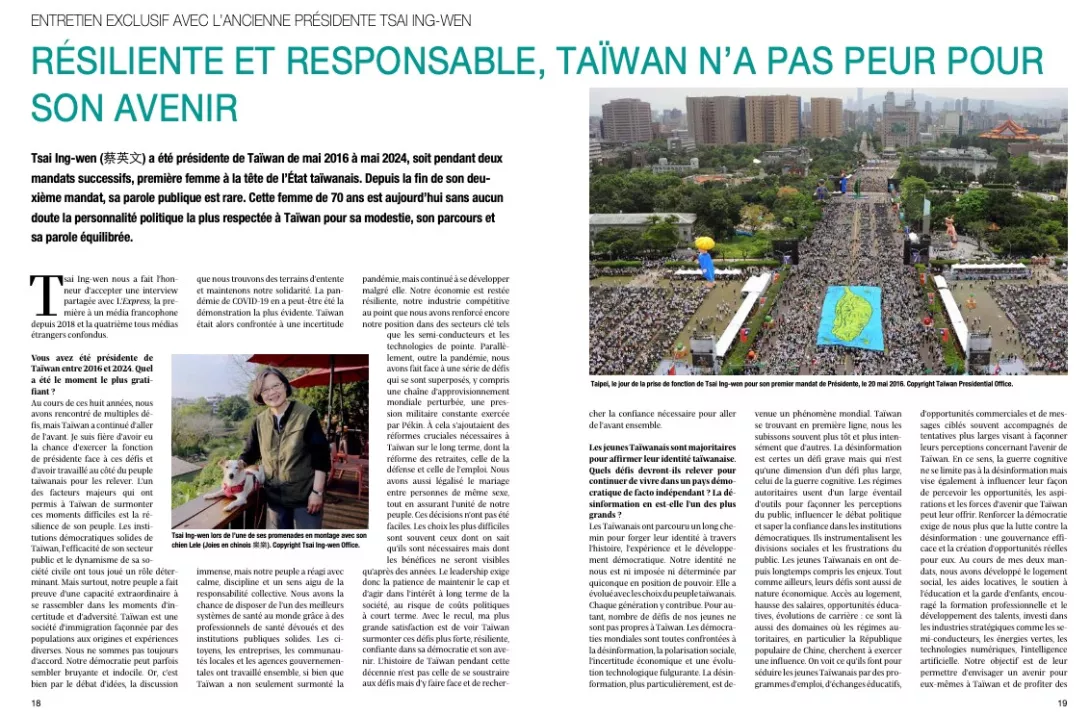
Former President Tsai Ing-wen recently granted an exclusive interview to Pierre-Antoine Donnet, Editor-in-Chief of Asia Magazine and former Editor-in-Chief of Agence France-Presse (AFP). The interview marked former President Tsai's first interview with a French-language media outlet since 2018. It was also one of her very few public interviews since completing her second term as President in May 2024. In this interview, former President Tsai reflects on Taiwan's democratic resilience, regional security, cross-Strait relations, and Taiwan's place in an increasingly uncertain international environment. The following is the English version of the interview.
Q: You served as President of Taiwan from 2016 to 2024. What was the most rewarding moment?
A: Over the past eight years, we have faced many challenges, but Taiwan has continued to move forward. I am proud to have had the opportunity to serve as President in the face of these challenges and to have worked alongside the people of Taiwan to overcome them.
One of the key factors that has enabled Taiwan to weather these difficult times is the resilience of its people. Taiwan's strong democratic institutions, its efficient public sector, and its vibrant civil society have all played a crucial role. But above all, our people have demonstrated an extraordinary ability to come together in times of uncertainty and adversity. Taiwan is a society of immigrants shaped by people of diverse backgrounds and experiences. We do not always agree. Our democracy can sometimes seem noisy and unruly. Yet it is precisely through the exchange of ideas and discussion that we find common ground and maintain our solidarity.
The COVID-19 pandemic was perhaps the clearest demonstration of this. Taiwan faced immense uncertainty at the time, but our people responded with calm, discipline, and a strong sense of collective responsibility. We are fortunate to have one of the best healthcare systems in the world, thanks to dedicated healthcare professionals and robust public institutions. Citizens, businesses, local communities, and government agencies worked together, so that Taiwan not only overcame the pandemic but continued to thrive despite it. Our economy remained resilient, and our industry remained competitive to the point that we further strengthened our position in key sectors such as semiconductors and advanced technologies. At the same time, in addition to the pandemic, we faced a series of overlapping challenges, including a disrupted global supply chain and constant military pressure from Beijing. Added to this were crucial reforms needed in Taiwan for the long term, including pension, defense, and labor reforms. We also legalized same-sex marriage, thereby preserving the unity of our people.
These decisions were not easy. The most difficult choices are often those we know are necessary, but whose benefits will only become apparent years later. Leadership therefore requires the patience to stay the course and act in the long-term interest of society, even at the risk of short-term political costs. Looking back, my greatest satisfaction is seeing Taiwan emerge from these challenges stronger, more resilient, and confident in its democracy and its future. Taiwan's story over this decade is not one of shying away from challenges but of facing them head-on and seeking the trust needed to move forward together.
Q: The majority of young Taiwanese people assert their Taiwanese identity. What challenges will they face in continuing to live in a de facto independent democratic country? Is misinformation one of the biggest challenges?
A: The people of Taiwan have come a long way in forging their identity through history, experience, and democratic development. Our identity is neither imposed on us nor determined by anyone in a position of power. It has evolved through the choices of the Taiwanese people. Every generation contributes to it.
That said, many of the challenges facing our youth are not unique to Taiwan. Democracies around the world are all facing disinformation, social polarization, economic uncertainty, and rapid technological change. Disinformation has become a global phenomenon. Because Taiwan is on the front lines, we often experience these challenges earlier and more intensely than others. While disinformation is certainly a serious challenge, it is only one aspect of a broader challenge: cognitive warfare.
Authoritarian regimes employ a wide range of tools to shape public perceptions, influence political debate, and undermine trust in democratic institutions. They exploit social divisions and public frustrations. Young Taiwanese have long understood what is at stake. Just as elsewhere, their challenges are also economic in nature. Access to housing, rising wages, educational opportunities, and career advancement: these are also areas where authoritarian regimes, particularly the People's Republic of China, seek to exert influence. We see what they are doing to court young Taiwanese through employment programs, educational exchanges, business opportunities, and targeted messaging, often accompanied by broader attempts to shape their perceptions regarding Taiwan's future. In this sense, cognitive warfare is not limited to disinformation but also aims to influence how they perceive the opportunities, aspirations, and future strengths that Taiwan can offer them. Strengthening democracy requires more from us than just combating disinformation: it requires effective governance and the creation of real opportunities for them.
During my two terms in office, we have expanded social housing, rental assistance, support for education and childcare, promoted vocational training and talent development, and invested in strategic industries such as semiconductors, green energy, digital technologies, and artificial intelligence. Our goal is to enable them to envision a future for themselves in Taiwan and to benefit from the gains brought by economic growth. Democracy can never be taken for granted. It must be preserved. Taiwanese people understand this well and demonstrate a keen sense of civic responsibility, a commitment to democratic values, and a clear understanding of the issues at stake.
Q: Tensions on both sides of the Taiwan Strait are escalating. Is the Taiwanese public prepared to face a crisis between the two sides of the Taiwan Strait? Is Taiwan sufficiently prepared for a coercive measure such as a blockade?
A: Should signs of a crisis emerge, our priority would be to work with the international community to prevent any escalation. If, despite our efforts, a crisis, such as a blockade, were to occur, Taiwan would be prepared and resilient. We have spent years strengthening our ability to withstand different forms of coercion by stockpiling essential supplies, diversifying energy sources, strengthening communication networks, protecting critical infrastructure, and ensuring the continuity of essential services.
These efforts continue under the current government and remain a national priority. Taiwan is better prepared today than at any other time in its recent history. But resilience also depends on the determination and adaptability of the Taiwanese people and must be underpinned by effective deterrence. During my two terms in office, we have strengthened our asymmetric defense capabilities, invested in precision strike, maritime, and air defense systems, reformed the reserve forces, and improved civil defense preparedness. We are working closely with our democratic partners on information security and resilience. The better prepared we are, the stronger our deterrence. Preparedness demonstrates resolve, and resolve strengthens deterrence.
It is also crucial to understand the global stakes involved with Taiwan. The Taiwan Strait is one of the world's most important trade routes, and Taiwan plays a central role in the global technology supply chain. We produce 70% of the world's semiconductors and as much as 95% of advanced chips, making us an essential pillar of the global AI revolution. The Rhodium Group has estimated that a conflict involving Taiwan could result in economic losses of around $2 trillion, exceeding the global impact of the war in Ukraine. A prolonged conflict would disrupt the global supply chain and significantly slow down technological innovation and AI development for years to come.
Q: What lessons can be learned from the war in Ukraine?
A: The Ukrainian experience is very instructive to us, and we are studying it very closely. The world has also learned lessons from it. The human cost of this war is immense. I would like to take this opportunity to pay tribute to the Ukrainian people. Through their sacrifices, the world has come to realize the true cost of conflict and the importance of preserving peace. Ukraine's resistance is extraordinary and has demonstrated what a determined democratic society can achieve in the face of a far larger adversary. It has sent a strong message: the cost of military aggression can be far higher and more enduring than many realize.
One of these lessons is that it is not easy to conquer a society determined to defend its freedom and way of life. Ukraine has also shown that coercive tactics aimed at weakening and dividing a society can backfire. Similarly, Russia's hope of subduing Ukraine quickly at relatively low cost has proven to be a serious miscalculation. This war has demonstrated that when the international community recognizes the magnitude of a shared challenge, it can mobilize substantial and lasting support. Undoubtedly, China is studying all of this closely. Furthermore, since the Chinese economy is far more integrated into the global economy than Russia's, the consequences of any conflict would be significantly greater for both China and the world.
Q: Many in Europe view Taiwan as a distant problem. What is your response to them?
A: Taiwan is not as far removed from Europe's interests as it may seem. In today's interconnected world, Taiwan is important because of its indispensable role in the global economy, regional security, and the defense of democratic values. All European industries that depend on cutting-edge technologies have a direct stake in stability in the Taiwan Strait. Semiconductor supply chains between democratic partners represent a shared economic and security interest.
Second, Taiwan occupies a key strategic position in the Indo-Pacific. In this interconnected world, security challenges in one region quickly become those of others. Third, Taiwan is one of Asia's most dynamic democracies. As authoritarian regimes grow increasingly assertive, Taiwan is on the front lines of a broader challenge facing all democratic societies. Eighty years after World War II, the lesson is clear: when democracies lower their guard against threats to peace and stability, the consequences eventually affect everyone. The world today is so interconnected that we cannot separate our own security from that of others. This is why Taiwan's importance far exceeds its size: whether in the realm of technology, security, or democratic values, we all have a stake in preserving Taiwan's peace and stability.
Q: You say that Taiwan occupies a key strategic position at the heart of the first island chain in the Pacific Ocean. If China were to take control of Taiwan, would that alter the military balance in Northeast Asia?
A: Countries in the Indo-Pacific region are closely monitoring developments in the Taiwan Strait because they understand that peace and stability there are directly linked to the security and prosperity of the entire region.
A crisis in the Strait would not be an isolated event; its consequences would be felt far beyond Taiwan. Japan, for example, is increasingly emphasizing the importance of peace and stability in this area. Other countries in the region also recognize that developments in the Taiwan Strait have significant implications for regional security. Taiwan's geographical location is often discussed in the context of the first island chain stretching from Northeast Asia through Taiwan and the Philippines to Japan.
For many countries in the region, this geographical configuration is closely linked to the broader security architecture that has helped preserve peace and stability in the Indo-Pacific for decades. In other words, Taiwan is not alone in facing growing challenges. Many countries share a common interest in preserving peace and stability in the Taiwan Strait because they know that Taiwan's security is closely linked to that of the region as a whole. That is why maintaining the status quo and strengthening deterrence remain issues of broad international concern.
Q: China is becoming increasingly powerful on the world stage. Is this a growing threat to the world?
A: The key issue is not simply China's growing power, but how it chooses to exercise that power. It does not hesitate to use economic pressure and other coercive measures against countries, entities, and individuals that maintain ties with Taiwan or simply express support for it. What China is doing in the South China Sea and the Taiwan Strait, just like its economic coercion, aims to isolate Taiwan. Its attempts to manipulate and pressure international institutions such as the WHO and Interpol reveal an identical recurring pattern.
China uses its power not only to pressure others but also to change established norms and challenge the rules-based international order. This raises concerns about the future of the principles that have governed international peace and stability for decades, including the peaceful settlement of disputes, freedom of navigation, respect for international law, and the principle of non-political interference. Beijing’s strategy is to subjugate while remaining below the threshold of open war. It weakens and divides the societies it targets through military threats, economic coercion, and sophisticated disinformation campaigns. This approach often backfires, as it heightens awareness of the threat, erodes trust in China, and deepens solidarity among the targeted populations.
Q: The United States has been one of Taiwan's main supporters. How important is this support for Taiwan's future?
A: The United States has long been an important partner of Taiwan. Its support is significant for Taiwan as well as for the international order more broadly, having helped maintain peace, stability, free trade, and freedom of navigation for decades. Taiwan has benefited greatly from this, as have many countries around the world. The ties between the United States and Taiwan are important economically, strategically, and politically. They send a strong signal regarding democratic solidarity and the shared interest in maintaining peace and stability in the Indo-Pacific.
Throughout my two terms in office and under the current administration, I have observed continuity across successive U.S. administrations regarding the fundamental principles of the importance of peace and stability in the Taiwan Strait and the conviction that disputes between the two sides of the strait must be resolved peacefully and without coercion.
Peace in the Taiwan Strait serves the interests of all parties concerned. That is why Taiwan is striving to strengthen its ties with the United States and deepen its relations with Europe, Japan, and other democratic partners. We seek to build a broader network of cooperation among countries that share an interest in regional stability and an open international order. But above all, Taiwan has a responsibility to strengthen its own resilience. Every citizen has a role to play in protecting our future. This is the foundation of deterrence.
The United States will continue to play a leading role in upholding the international order. This leadership is important both for Taiwan and for the international community as a whole. Taiwan's security is increasingly linked to regional stability, economic security, and the future of democratic cooperation. Therefore, support for Taiwan is not simply about Taiwan itself. It is about preserving a rules-based order that benefits everyone.
Q: Taiwanese society appears to be polarizing. Are you concerned that China might exploit these divisions?
A: There is no doubt that authoritarian regimes seek to exploit divisions within democratic societies. But if they understand how democracies work, they should also understand that disagreements, debates, and divergent interests are not signs of weakness but natural characteristics of a free and open society.
In a democracy, people can sit down, discuss issues, reach a compromise, and, from there, move forward together. This happens almost every day in a democracy. There are differences of opinion and interest, followed by compromises that allow us to move forward. The next day, new conflicts arise that must be addressed once again. It is a never-ending process. But the advantage of democracy is that even though it may sometimes seem chaotic, it has a mechanism that allows citizens to debate, fight for what they believe in, and protect their interests.
Ultimately, a government, a judicial system, and mediators serve as arbiters to facilitate compromise. In a democracy, this is natural. I can hardly imagine one that is peaceful, without conflict. In Taiwan, we are a young democracy with conflicts, debates, and clashes among us. This is our daily reality. But the fact remains that all Taiwanese share a belief in democracy. They enjoy freedom and all kinds of rights. This is a common and collective good. We must work hard to protect what our democratic and free society provides us.
Q: Beijing is trying to convey the message that China and Taiwan are part of the same culture. Do you think this narrative is capable of convincing the Taiwanese people?
A: Taiwan has changed significantly over the past three or four decades and has influences from around the world. There are American, Japanese, and, to some extent, European influences. We connect with the world and its values to align them with our economic and security interests. Culturally, therefore, we are much more than just a Chinese culture. Of course, we speak Chinese. But the fact is that we are a democracy and a society open to the world, and that the population is free to embrace other cultures.
Q: When they travel abroad, Taiwanese people enjoy saying, "I am Taiwanese." What do you see behind that statement?
A: I think they are proud to be Taiwanese. Despite our difficulties in diplomatic relations or in being recognized as a country by others, everyone knows who Taiwan is and who the Taiwanese are. They understand Taiwan's importance in the global economy and its security challenges. Taiwan projects a positive image because we contribute to the world. We are proving indispensable to future technological development and, moreover, we are a free and democratic society. This remarkable progress explains why the international community views Taiwan as a success story.
Q: When you were president of Taiwan, was being a woman accepted by Taiwanese society?
A: The very fact that I was elected shows just how much Taiwanese society had accepted being led by a woman. Let me tell you this: when I was elected president in 2016, the victory was very clear. It showed that Taiwanese people accept the idea, and to a certain extent, appreciate having a female president. In 2020, when I was re-elected, I received the highest number of votes ever recorded in a presidential election in Taiwan. This means that Taiwanese people do not care about gender when choosing their leaders. I am proud of the Taiwanese people and their choice. It speaks to the level of progress in Taiwanese society, as well as its openness.
The original French version of this interview was published in Issue 8 of Asia Magazine (July 25).