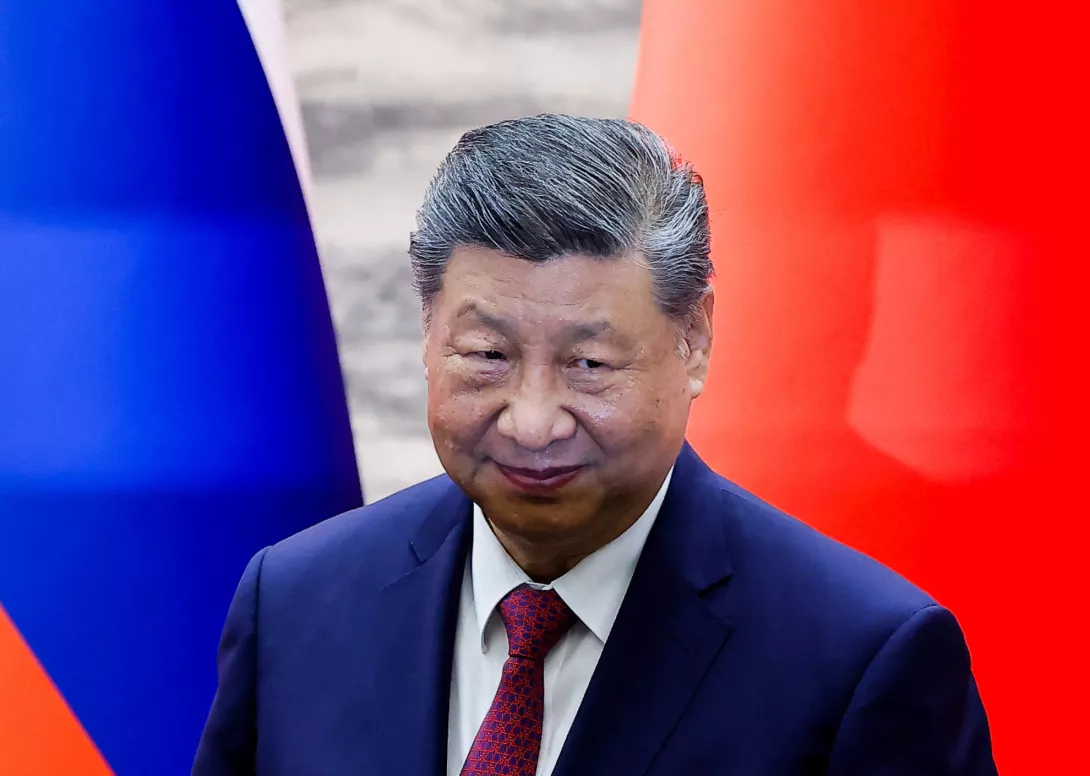
This special series was inspired by the curiosity of a simple but increasingly important question: after the Trump–Xi summit in Beijing, how might Xi Jinping now be thinking about Taiwan, the United States, and the future balance of power in the Indo-Pacific?
To explore that question, Thinking Taiwan English Edition invited renowned China scholar Andrew J. Nathan of Columbia University to engage in a provocative intellectual exercise: to "read Xi Jinping's mind." The result is an imagined reconstruction of how Xi himself might interpret the strategic environment following the summit — from the future of U.S.–China relations to Taiwan's increasingly uncertain place within the evolving regional order.
We then invited four leading scholars from Taiwan to respond from different intellectual and disciplinary perspectives. The contributors include Chien-wen Kou, Distinguished Professor in the Department of Political Science and the Graduate Institute of East Asian Studies at National Chengchi University; Jieh-min Wu, Distinguished Research Fellow at the Institute of Sociology at Academia Sinica; Chen-Dong Tso, Professor of Political Science at National Taiwan University; and Yi-feng Tao, Associate Professor in the Department of Political Science at National Taiwan University.
The result is a dialogue and a broader intellectual exchange on how Taiwan, China, and the democratic world should understand the evolving post–Trump-Xi strategic landscape. At a moment of intensifying geopolitical uncertainty and shifting assumptions about deterrence, power, and credibility, these essays explore not only how Beijing may view the world, but also how the world should understand Beijing.
Andrew J. Nathan: This is my attempt to imagine what Xi Jinping might be thinking about Taiwan; though I do not necessarily agree with every idea I attribute to him.
Now is a good time to attack. Trump's weakness was fully on display in our Beijing summit last week. Even before we met, he left security issues and almost all human rights issues off the agenda when he appointed Treasury Secretary Scott Bessent to negotiate the agenda for the summit. That meant we would focus on trade and investment issues, and trivial ones at that, with vague outcomes. I didn't need to push Trump to say he "opposes" Taiwan independence: he had already done enough damage to U.S. credibility before his visit. After he left, he acknowledged that we talked a lot about Taiwan, and he admitted that Taiwan arms sales are on the table for negotiations with us. But while on Chinese soil, he did not dare offer a public response to my warning not to cross our Taiwan red lines. "Stabilizing" and "reducing tension" in the relationship benefits us more than the U.S., as we are on a rising trajectory anyway. The trade truce leaves us holding all the cards we were holding before.
To be sure, I'm impressed by the U.S. military skills displayed in Iran, like the use of artificial intelligence to provide precise targeting. But Trump knows that I know the Americans are low on weapons thanks to this foolish war. Even our enemies in Taiwan have gotten the message: Washington won't be able to defend Taiwan until it rebuilds its arsenal. But even then, the U.S. would intervene only if Trump were willing to fight. But he only likes to pick on weak powers. Iran taught him that even weak powers are not so easy to beat. In fact, he's going to pay a big price in the midterm elections for his unpopular war.
And China is not a weak power. I made it clear to him again that I'm serious; our people are determined. We are close to Taiwan, the U.S. is far away, and most Americans don't really care. I could attack now and Trump wouldn't dare to fight back.
The Americans seem to think that my purge of top generals means my military is not ready to go. Sure, they were corrupt. But I didn't purge them for corruption, but for lack of readiness. The old generals were divided among themselves over how to attack Taiwan. Their plans were too cautious; they wanted more time to prepare. I'm bringing up younger generals who are tough and willing to fight, who understand modern warfare, and above all who get the message: stop fighting among themselves and give me options that will work, ranging from decapitation to blockade to invasion. The younger guys will do that, and fast.
But why bother? I have a better plan. I'm going to get control over Taiwan by the end of my fifth term [October/November 2037] and then I'll retire. I'll go down in history as China's greatest leader, not just in PRC history but ever.
Two trends are in my favor. Sure, official Washington policy is what it has always been: use Taiwan to "contain, encircle and suppress" China. But the traditional U.S. Taiwan policy has become empty talk. More and more officials and think-tankers know the U.S. can't afford to fight us, and if they tried, that they could not win. Sure, the U.S. would threaten us with sanctions. But we have already decoupled from the U.S. in technology and trade in every way that matters. We dominate in most areas of 21st century advanced technology and, with our huge engineering force and government investment, we'll soon be ahead in advanced chips and artificial intelligence. They say we have to stop flooding the world with manufactured goods, but there's still a lot of stuff they have to buy from us, and anything they don't buy, we are selling elsewhere. Our system works. Theirs is failing.
No wonder Washington is full of proposals for pulling back and letting Asian powers defend their own interests. But Japan and South Korea are not going to fight for Taiwan. Taiwanese read the newspapers and think tank reports. They get the message.
In Taiwan, most voters and both major parties would like to maintain the status quo. But it should be clear by now that I'm not going to fall for that. Status quo is de facto independence, and I want to put an end to it. I learned from the wars in Ukraine and Iran that the key to beating a smaller power is not to bomb them over and over, but to erode the will to resist. We're putting all kinds of pressure on Taiwan, and it works. Voters and politicians are more and more scared of us.
I'm not under any illusion that that Cheng Li-wun(鄭麗文)of the Kuomintang (KMT) and her group want us to take over; they just think they can keep us from ramping up pressure if they assure us they are against independence. On the other side, DPP's Lai administration wants to arm Taiwan and build up energy and food resilience so it could, in theory, defend itself without American help if it had to. In fact, we know that the Americans are coaching them to do this. But they couldn't get their full arms budget through the Legislative Yuan. Now Trump is afraid to approve the next arms sales package that was scheduled before the summit. Even if Trump authorized more arms and the LY approved the full budget, it would take a long time, if ever, to acquire the weapons and train to use them. And even then, we could overcome any so-called porcupine resistance strategy with the weapons and forces we have.
I'll keep up military pressure and keep flooding Taiwan media with blandishments and threats. Some people think we've offended the Taiwanese so much with diplomatic and military pressure that they'll never surrender. But public opinion in Taiwan is changing. Trade and investment with us are essential to Taiwan's standard of living. Our standard of living up and down the mainland coast will soon be equal to that of Taiwan. Investments are safe; property rights are protected; city parks are beautiful; the streets are safe; public transportation works; social workers check in on retired people to make sure they are safe. We surveil people for their own benefit. There's too much political chaos in Taiwan. Here we provide a wonderful feeling of security. Life is better here than in Taiwan.
People used to say that our crackdown in Hong Kong killed the idea that "one country two systems" would work for Taiwan. But look at Hong Kong now. There's no political disorder and the economy is flourishing. People are living happy lives, as they do on the mainland. Taiwan people see this and they are going to want our way of life.
The key to victory is changing minds in Washington and in Taiwan. History is on my side. I am 73 years old and my health is good. I have time. As Sunzi said, "To subdue the enemy without fighting is the highest excellence(不戰而屈人之兵,善之善者也)"。 Trump has one thing right: I am "one of the world's great leaders"!