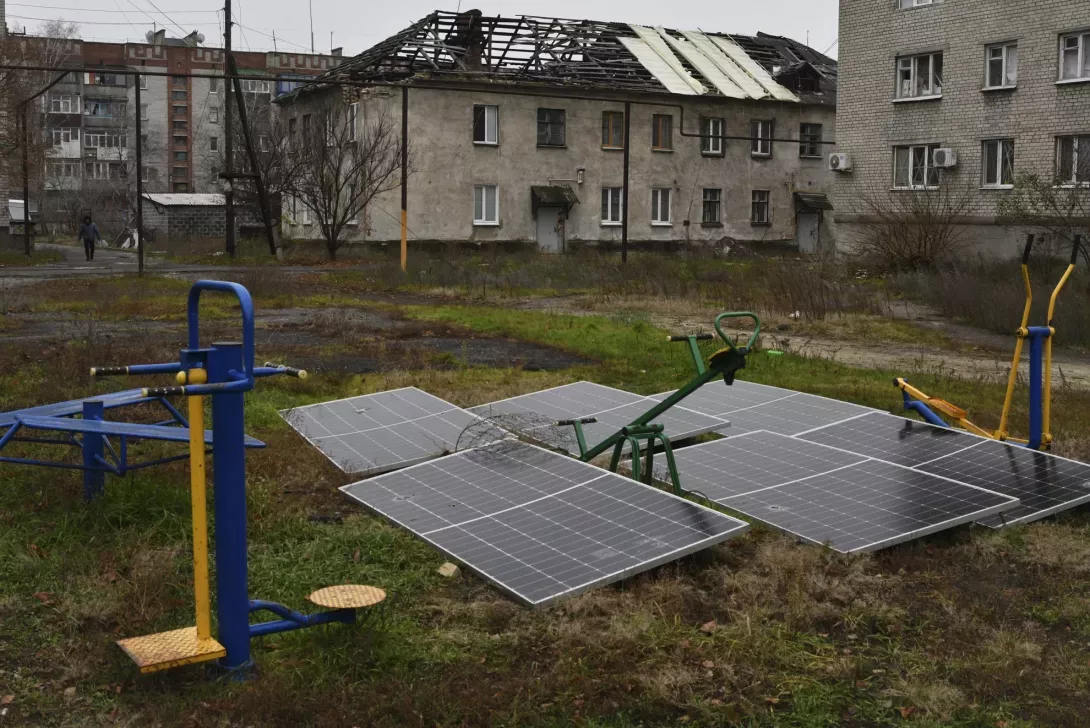
- Ukraine’s experience shows that having distributed renewable energy lowers risks and bolsters defense as it can be deployed, replaced, and brought back online quickly.
- Ukraine has shown the world that the goals underlining the “energy trilemma” need not compete; they should be mutually beneficial. Distributed renewables can deliver energy security, affordability, and sustainability at the same time.
- A real energy transition means redesigning how energy is produced, financed, and consumed, and how its benefits are shared, toward a more resilient system.
During Climate Week NYC 2026 this September, I took part in a side event titled “What the World Can Learn from Ukraine’s Energy Resilience.” It was a discussion among leaders from national and local governments, energy companies, and civil society to share experiences from the frontline. Together they took up a question that matters a great deal to both Taiwan and the world at large: when an energy system suffers a severe shock, how should we respond, and how can we make the system more secure and resilient?
Drawing on my observations at the forum and on related reports, this article looks at the energy resilience Ukraine has built despite being under immense strain. It covers the energy challenges Ukraine’s cities have faced and how distributed renewable energy has helped keep society running on a damaged grid. It also shows how Ukraine has used international support, industrial transformation, and public participation to build a capacity for survival that strengthens energy security, equity, and sustainability, the three goals of the energy trilemma.
Wartime Energy Risks and Challenges
According to the International Energy Agency (IEA) report Energy System Resilience: Lessons Learned from Ukraine, Ukraine’s energy infrastructure was attacked about 4,500 times in 2025, and about 9 GW of generating capacity was lost in 2024 alone. By mid-January 2026, electricity demand stood at 18 GW, but available capacity was only about 11 GW. In some areas, including the capital Kyiv, outages could last for more than 17 hours.
At the Climate Week event, the reality behind these figures was brought home. Lithuanian Energy Minister Lukas Savickas said that energy itself is becoming a target and that energy infrastructure is being deliberately targeted for attack. In recent years, Lithuania has pushed ahead with its own shift to renewables and cut off imports of Russian gas, electricity, and oil. It has also supplied Ukraine with equipment including solar panels, batteries, transformers, and generators to help it withstand attacks and get through the winter.
Ukraine’s experience shows that conventional large, centralized power plants are particularly vulnerable in times of crisis. By contrast, distributed renewable energy lowers risks and has distinct advantages when it comes to defense – it can be deployed, replaced, and brought back online quickly.
Another event participant, Oleksandr Syenkevych, mayor of Mykolaiv in southern Ukraine, described how the city has rolled out distributed energy systems. Mykolaiv has installed solar panels on hospital rooftops, kept the water supply running with boreholes and reverse osmosis systems, and fitted hospitals with boilers that burn biofuel the city produces itself. Operating rooms and intensive care units, he said, can now run independently on solar power. Residents have also joined energy-saving projects. The city covers half the cost of energy-efficiency upgrades as well as battery and solar installations, helping ensure that elevators and heating systems keep working during outages. More than 12,000 apartment-building residents have taken part in the initiative so far. Syenkevych said that the people are not just trying to survive; they are thinking about the future of the city and the planet.
Jeff Oatham, chief sustainability officer at DTEK, Ukraine’s largest private energy company, described the risks of conventional energy supply from an industry perspective and stressed the importance of shifting to renewables. DTEK was once a thermal power producer supplying one-fifth of Ukraine’s electricity. Since Russia’s full-scale invasion in 2022, its generating facilities have been attacked more than 200 times.
Oatham explained that while the company has been repeatedly repairing and rebuilding their facilities, they made the decision to invest in expanding distributed renewable energy. Oatham made this necessity clear, stating that a single missile could destroy a 250 MW thermal power plant, but causing comparable damage to one wind farm might take around 40 missiles. And even if one wind turbine is destroyed, all the others keep running. For defense, that is the biggest difference between conventional centralized generation and distributed renewables.
DTEK is now helping more small- and medium-sized enterprises across Ukraine install solar-plus-storage systems to make their businesses more energy resilient. The company has also adopted the concept of “security by design”: multilayered defenses, covering both cybersecurity and hardware protection, that are built into its energy facilities from the design stage. DTEK designs in multiple layers of redundancy, so that the system can keep running even if part of it is damaged.
Resilience Beyond the Energy Trilemma
Oatham summed up several lessons from Ukraine that show how a country at war and its energy sector can find a way forward through reconstruction, decarbonization, and energy resilience.
First, decentralization. Deploy distributed renewable energy to reduce the risk of single points of failure.
Second, speed is resilience. Wartime experience shows that the speed at which energy facilities can be built, repaired, replaced, and brought back online is key to resilience.
Third, security and clean energy are part of the same agenda. Investing in distributed renewables, energy storage, and modern smart grids cuts carbon emissions and improves energy security at the same time.
Fourth, security by design. From the outset, energy systems should be designed for decentralization, redundancy, physical protection, cybersecurity, and rapid recovery.
Oleksii Riabchyn, chief international and sustainability officer at Naftogaz Group, one of Ukraine’s largest energy groups, noted that since Russia’s full-scale invasion, energy, oil, and gas are no longer just economic and industrial issues. They have become a part of the battlefield. Naftogaz has to keep up energy supply and security in wartime while still pursuing decarbonization and a long-term energy transition.
Naftogaz faces the same energy trilemma as Ukraine. The challenge is to balance affordability, energy security, and sustainability while war keeps energy infrastructure under constant threat. On top of this, Naftogaz is working to redesign the energy system to be cleaner, more secure, more decentralized, and more resilient.
Having energy that is cheap, secure, and clean all at once was long thought nearly impossible, so policymakers were expected to make trade-offs between the three. The war in Ukraine shows that the energy trilemma can no longer be treated simply as a set of goals that crowd one another out. Ukraine has in fact presented a way for the three goals to be mutually reinforcing. Distributed renewable energy has gone from being seen as infrastructure for decarbonization to infrastructure for resilience, and it can deliver energy security, affordability, and sustainability simultaneously.
The Closer to Consumers, the Greater the Energy Security
Responding to energy shocks and making systems more secure and resilient is not just about rethinking where our electricity comes from. We need to reconsider how to transform entire energy systems, from how energy is produced, transmitted, and consumed, to how the system is designed.
Renewable energy, energy storage, energy efficiency, and energy management are the building blocks of a distributed power system. Seen through the lens of energy resilience, part of their value lies in how much power they generate or how much carbon they cut. But just as important a part lies in their vital contribution to keeping society’s basic functions running when outages or disasters strike.
Facing persistent blackouts and power rationing caused by the war, Ukrainian households and businesses have begun installing their own solar panels. Their goal is no longer just to cut emissions or lower electricity bills, but to take control of their own access to power. While renewable facilities can be damaged, Ukraine has kept expanding renewable capacity since the outbreak of the war. Estimates based on Ukrainian government and IEA data indicate that 2.2 to 2.3 GW of renewable capacity was added between 2022 and 2025. An IEA report further shows that as of 2024, consumers themselves had installed about 1.5 GW of solar capacity.
Civil society has also become a pillar of Ukraine’s energy resilience. At the forum, Yuliana Onishchuk, founder of the Energy Act for Ukraine Foundation, shared the case of a school in Borodianka, a project driven by the public. The foundation helped the school install a solar-plus-storage system of about 70 kW. During long winter blackouts and heating outages, there were times when the school was one of the few buildings in the community that still had power. Children could keep going to school and residents could come to charge their phones.
Beyond turning schools and other public facilities into community resilience hubs, Onishchuk also raised the challenge of scaling up. When the main grid fails, there needs to be a way for a community’s distributed solar, wind, and storage facilities to switch to a microgrid in “island mode” – an operational state independent of the main grid. Doing so could sustain hospitals, water supply, shelters, communications, and other basic needs across a wider area, and even keep power flowing to thousands of people. Onishchuk prefaced these comments by saying that institutional barriers still need to be overcome. The school produces surplus solar power, for example, but cannot yet supply it directly to a nearby kindergarten. This shows that local power sharing on a larger scale, as well as regional energy resilience, still face hurdles under the existing grid system.
In short, Ukraine has sped up its decarbonizing energy transition during the war. Through renewables, storage, and other distributed energy resources, it has found a new way to reconcile energy security, affordability, and sustainability. In her closing remarks, Svitlana Romanko, a Ukrainian-born climate and energy advocate and founder of Razom We Stand, said Ukraine’s wartime experience is redefining energy security and energy resilience. Energy security, she stressed, means keeping energy producers as close as possible to consumers. In other words, a truly resilient energy system should not rely too heavily on large, centralized facilities. It should bring renewables, distributed generation, and microgrids closer to local communities and to what users actually need.
A Whole-of-Society Undertaking
As another winter approaches, energy facilities across Ukraine continue to suffer serious damage. Rebuilding the energy system is not just a technical problem, it is also a financing problem. Romanko pointed out that while there is massive demand for renewable energy in local communities, private capital is a long way off being able to meet it. Public funds will be needed to lower investment risks, paving the way for private financing to come in. Using Ukraine’s cooperation with Norway as an example, she explained how public funds can be directed to the deployment of renewables in these communities. Using mechanisms such as local investment funds, part of the financial returns from renewable projects can then be reinvested in communities, public services, water supply, and electrification, creating a self-sustaining cycle of local investment.
Romanko argued that Ukraine cannot simply rebuild the old, damaged system. There are several things it also needs to work on at the same time: energy market reform, distributed renewables, smart microgrids, public funding and private finance, and benefit-sharing mechanisms for local communities. Together, these are what will reshape the relationship between energy producers, consumers, and capital. Especially where energy poverty persists, financing mechanisms should not chase commercial returns alone. They have to ensure that vulnerable households and local communities can take part in and benefit from the energy transition. In moving from wartime survival to reconstruction, a real transition means more than repairing energy infrastructure. It means redesigning how energy is produced, financed, and consumed, and how its benefits are shared, to build an energy system that is more decentralized, fairer, and more resilient.
Ultimately, Ukraine’s efforts to rebuild energy resilience under fire offer the world valuable lessons grounded in real-world experience. Taiwan, and countries around the world, should not wait until a crisis or climate disaster strikes to start building this kind of energy resilience infrastructure and capacity.
Ukraine’s experience teaches us that energy resilience is a whole-of-society undertaking that goes beyond the energy transition or making technical adjustments. In a truly resilient energy system, individuals, businesses, municipalities, and the state can all take part. Together they build a system that keeps hospitals, schools, and social services running through major shocks, lets communities carry on with daily life, and makes sure the most vulnerable are not left behind.