- Italy's withdrawal from the Belt and Road Initiative created greater room for renewed engagement with Taiwan.
- Taiwan has gained broader political support in Italy, with engagement expanding across party lines and becoming less dependent on any single political camp.
- Economic and technological cooperation, especially in semiconductors and advanced industry, is giving the relationship greater substance beyond political exchanges.
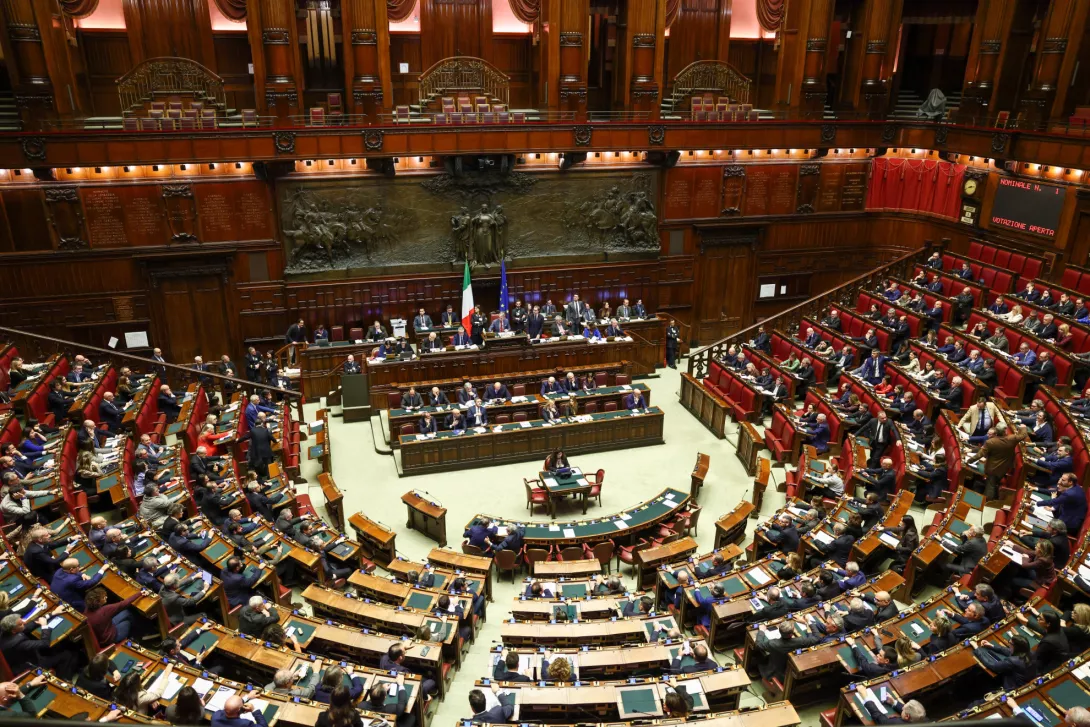
In the first days of September 2026 ten Italian parliamentarians led by the vice-president of the Senate, Gian Marco Centinaio, were received by President Lai Ching-te in Taipei and, the following day, opened the Italian pavilion at SEMICON Taiwan. It was the fourth cross-party delegation from Rome in twenty months. Three months earlier the former president Tsai Ing-wen had spent several days in Italy, and in the same days the foreign minister Lin Chia-lung was in Milan. A week after the delegation flew home, Vice President Hsiao Bi-khim landed in Italy herself. For a country whose foreign policy has never reached the Taiwan Strait, this is a lot of traffic, and it is worth asking what it means.
Whenever Rome and Taipei have sat down together, someone else has been at the table. It was always Washington, and behind Washington the pull of Beijing, which has shaped Italian political and diplomatic choices without interruption. The Atlantic tie has been the fixed point of Italian foreign policy since 1949, but for most of that time it carried no obligations in East Asia. Rome’s attention ran towards Washington, Brussels and the Mediterranean, and none of those lines came anywhere near Taiwan. What did travel that far was an idea shared by governments of every colour, including the most loyally Atlanticist: that China was too large an opportunity to pass up. The values Italy and democratic Taiwan came to share were real, but for decades they were rarely spoken aloud.
A country with no Asia policy still has to say something when the question comes up, and in the Italian case the formulations chosen, the nouns and verbs of a communiqué or a parliamentary motion, have carried the weight that elsewhere is carried by treaties and deployments. In November 1970 the one thing Rome chose in the recognition talks with Beijing was a noun: the communiqué recorded a Chinese «declaration» on Taiwan, not a position, and Italy «took note» of it. The Taiwanese archives add a detail that the Italian and American accounts had missed. The formula did not come from Ottawa, whose communiqué of 13 October is usually credited with it; a Chinese representative had put it to the Italian negotiator in Paris five weeks earlier, and Rome, which had been proposing a French-style solution, took some time to accept a concession that turned out to suit everyone and that set the terms in which Taipei and the Western capitals have spoken to each other ever since. Taipei, for its part, wrote the terms of its own departure, declaring relations ceased from the moment of recognition rather than negotiating a rupture. In March 1996, during the Third Taiwan Strait Crisis, as Chinese missiles fell into the sea off the island, two senators spoke about Taiwan in the Italian Senate as a threatened democracy rather than a lost China, and Italian governments have spoken that way since. Adjustments of this kind are often the only diplomatic space a middle power has in a distant region, and both capitals have learned to use it well. In the 2023 article on Italian–Taiwanese relations for Il Politico, the open question was whether the language of the Meloni government, which had called the Taiwanese representative in Rome the «Taiwan ambassador» during the election campaign, would survive contact with the Farnesina, as the Italian foreign ministry is known, and with the Belt and Road Memorandum. The answer, three years on, is more encouraging than either the enthusiasts or the sceptics expected.
The Belt and Road, In and Out
Italy’s adhesion to the Belt and Road Initiative in March 2019 was framed in a European vocabulary. The Memorandum invoked the EU–China Connectivity Platform and the Union’s own strategy on Euro-Asian connectivity, and Giulio Pugliese showed at the time that it continued the trade and investment agenda of the Renzi and Gentiloni governments; Fabrizio Coticchia’s study of the Conte I cabinet nonetheless found it to be the only foreign policy act of that coalition that went «beyond the traditional perimeter of Italian alliances». What undid it was a gradual loss of legitimacy. American pressure was open and persistent, as Gabriele Natalizia and Lorenzo Termine have documented, but it landed on ground already prepared by an Italian public that was among the most China-sceptical in Europe, by an industrial world that had seen little of the promised market access, and by a political class that had watched Beijing’s conduct during the pandemic and over Hong Kong. When the Ministry of Foreign Affairs notified Beijing in December 2023 that the Memorandum would not be renewed, making Italy the first signatory to leave, the exit read as a return to alignment. Giovanni Andornino’s interviews with the diplomats involved show how carefully it was managed on both sides, with no announcement to speak of and no retaliation, and within weeks the two governments were celebrating the twentieth anniversary of the 2004 strategic partnership. Meloni visited Beijing in July 2024; Wang Yi came to Rome in October 2025 for the twelfth session of the Italy–China Intergovernmental Committee.
Termine’s research on the centre-right parties, published this spring in the Journal of Contemporary European Studies, shows what that management cost Taipei in the short run. Between the government taking office in October 2022 and the Beijing visit, Taiwan-related engagement was kept deliberately low: the biennial Italy–Taiwan Economic, Industrial and Financial Cooperation Forum was not convened after its tenth session in December 2022, a parliamentary mission planned for April 2023 was postponed, and ministers said as little as possible. A single visible gesture toward Taipei could have complicated the exit, so none was made, and once the exit was complete the space held in reserve began to open.
The Oldest Channel
The channel that reopened is the oldest one the relationship has. Every significant step between Rome and Taipei since the 1950s has grown out of a journey, often undertaken in a private capacity — a holiday or an honorary degree — that turned into a mission once on the island. The first Italian parliamentary delegation reached the island in October 1956. The 1979 mission led by the Christian Democrat Bruno Stegagnini opened the modern era of informal relations. Giovanni Prandini’s trip in 1991, still the only one by a serving Italian minister, produced a wave of public works contracts, and the man who organised it from the minister’s office, Camillo Zuccoli, was the same young assistant who had accompanied Stegagnini in 1979 and who kept the channel between Rome and Taipei open, mostly unseen, until his death in 2019. Parliament has always done what the executive could not say.
Between late 2024 and this month the pattern resumed at a pace not seen in decades. In January 2025 Marco Osnato, chair of the Chamber’s Finance Committee, led a delegation that paired four members of Brothers of Italy with two deputies from the centre-left. In April 2025 the Italy–Taiwan Interparliamentary Friendship Group, chaired by Senator Lucio Malan and counting some ninety members, roughly fifteen per cent of the two chambers, issued its first statement condemning Chinese military exercises around the island. In September 2025 a second cross-party delegation attended SEMICON Taiwan. In January 2026 a third brought together six parties, from Forza Italia and Brothers of Italy to the Democratic Party and, for the first time, the Five Star Movement, whose government had signed the Memorandum in 2019; it met the foreign minister and toured the Hsinchu Science Park. Then came Centinaio’s mission this September, his fifth visit to the island. Lai thanked the delegation for the recent Italian law that allows Taiwanese artworks to be exhibited in Italy without fear of seizure at Beijing’s request; Centinaio told him that «supporting Taiwan means supporting the whole free world».
The delegations are bipartisan, with centre-left members on each of them — in a country where support for Taiwan had been a conservative affair since the Cold War — and the traffic runs in both directions. In October 2025 Taiwan’s foreign minister, Lin Chia-lung, came to Rome as the guest of Representative Vincent Y.C. Tsai to inaugurate the renovated Taiwanese office, the first visit of its kind in decades. His counterpart from the People’s Republic was due in the same city a few weeks later, on the first high-level Chinese visit since the exit from the Belt and Road. The Italian political presence at the Taiwanese ceremony was nonetheless massive: nine senators and nine deputies, from the majority and the opposition, a turnout that at other latitudes would have been unthinkable at that time. Where the delegations of the 1990s chased motorway contracts, those of 2025 and 2026 went to semiconductor fairs and science parks, after GlobalWafers had invested more than 300 million euros in a wafer plant in Novara, inaugurated in October 2025 as Europe’s largest 300-millimetre site.
What Grew Around the Silence
Below the level of government, the fabric of the relationship has thickened quickly. Taiwan opened a second representative office in Milan in 2023, headed by Riccardo Lin, to serve the industrial north, while the Rome office under Vincent Y.C. Tsai remains the political hub. An Italian Chamber of Commerce in Taiwan was established in 2025, chaired by Andrea Sing-Ying Lee, who had headed Taipei’s office in Rome when Meloni called him ambassador. Its co-founder and vice-president was Giuseppe Izzo, who died a few months ago after a long illness. Izzo had spent his professional life with STMicroelectronics, rising to run its Asia–Pacific public affairs and its Taiwan operations, and had chaired the European Chamber of Commerce Taiwan three times; Taipei gave him citizenship for special merit in 2019 and its Medal of Diplomatic Friendship in 2020, the same year Rome made him a Commendatore. With Zuccoli first, and then on his own, he did for the industrial side of the relationship what the parliamentary friendship group did for the political one, and the Chamber he helped found gives institutional form to a network he had built by hand over thirty-five years. The Chamber of Deputies’ Foreign Affairs Committee ran a fact-finding inquiry on the Indo-Pacific from May 2023 to March 2025, forty-three hearings in which Taiwan featured constantly and in which the undersecretary Maria Tripodi put on record Italy’s opposition to «any unilateral attempt» to alter the status quo in the Strait. Trade reached 5.37 billion euros in 2024, with an Italian surplus of just over a billion.
The one piece that has not moved is the Forum. As of March 2026 it had not been convened since December 2022. The Italian diplomats interviewed by Termine insist that «there are no political issues now blocking» it, unlike «the recent past», and attribute the delay to logistics. That is probably true, and an intergovernmental mechanism that has skipped two sessions while parliamentary delegations multiply also shows where the relationship is allowed to live. The CEIAS report on Europe–Taiwan relations, which includes an Italian chapter, files Italy under «pragmatist», a country with beneficial economic ties and a marked reluctance to pursue visible political ones.
Traffic Through Narrow Spaces
The arrangement of 1970 is holding, and it has adapted: the parliamentary channel has become bipartisan and has acquired a technological agenda that did not exist in 2023. The strain, such as it is, comes from Washington. In 2023 the American framing of Taiwan as a like-minded democracy was the key to Italy’s new posture. Under the second Trump administration Taiwan’s importance is expressed through export controls, arms packages and semiconductor policy, and rarely as the explicit subject of a values-based commitment, a condition described elsewhere as managed centrality. For decades, no news from Taiwan was good news, in Rome as much as in Taipei. Italian discretion made sense inside a wider Western conversation that supplied the words the Farnesina preferred not to say; if that conversation quietens, whatever Italy says on its own account will be listened to more closely. The government seems to have noticed: Termine’s sources report that Italy pushed for G7 language on the Chinese drills of December 2025 and early 2026, and that the Canadian and French presidencies declined.
In June 2026 Tsai Ing-wen was on Lake Como for the Global Women Leaders Summit convened by the Georgetown Institute for Women, Peace and Security. She shared the stage with former heads of government, and around the summit she fitted in a dense round of meetings with Italian lawmakers from both the majority and the opposition, with scholars and think-tank researchers, with Taiwanese students and with the business community, before being received at Palazzo Madama by Centinaio and Malan. Lin Chia-lung was in Milan in the same days, on his second visit to Italy in eight months, working on industrial and commercial ties.
Then came Ventotene. On 11 September, on the small Tyrrhenian island where Altiero Spinelli, Ernesto Rossi and Eugenio Colorni drafted the manifesto that Europeans treat as the founding text of their union, Vice President Hsiao Bi-khim spoke at the Second Ventotene European Conference for Freedom and Democracy, alongside European Parliament Vice President Pina Picierno, the former foreign affairs undersecretary Gianni Vernetti and the journalist Antonio Talia. Foreign Minister Lin Chia-lung travelled with her, in Italy for the third time in eleven months. Her presence was kept quiet until the delegation had landed, and Picierno, who convened the conference and announced the visit herself, explained the reason plainly: no one outside Europe decides who is heard on European soil. Beijing lodged solemn representations with Rome and with the European Union and called the initiative futile; the conference ran to its end as scheduled. None of these precautions took anything away from the visit, and they measured, more accurately than any statement could, how little Chinese objections now achieve. Italy’s formal position did not move an inch, and nobody expected it to. What moved was everything around it. Vernetti, who sat on that panel, had gone to Taiwan in 2007 as undersecretary for foreign affairs and had been obliged to travel formally on holiday, because that was the only way to go. Nineteen years later he was on a stage with a serving Vice President of the Republic of China, discussing how democracies protect one another.
Italy’s approach to Taiwan has always moved within narrow spaces, and it still does. None of the Italians in this story has stepped outside them: Centinaio and Malan at Palazzo Madama, the delegations in Taipei, Izzo and Zuccoli before them, all worked inside the limits that the arrangement of 1970 allows. What has changed is the density of the traffic through those limits, and the fact that nobody in Rome now feels the need to explain it. Seen together, the sequence is remarkably continuous: four parliamentary missions in twenty months, a foreign minister three times in under a year, a former president in June, a serving Vice President in September, and underneath them the wafer plant in Novara, the new chamber of commerce, the offices in Rome and Milan. The presence of Minister Lin and Madame Tsai, and now of Vice President Hsiao, marks a different level of attention from the one Rome and Taipei were used to. Taken as a whole, the past two years read as a symptom, the sign of a connection that has found, without anyone declaring it, a way of being taken for granted. Between Rome and Taipei, practice has outgrown form.