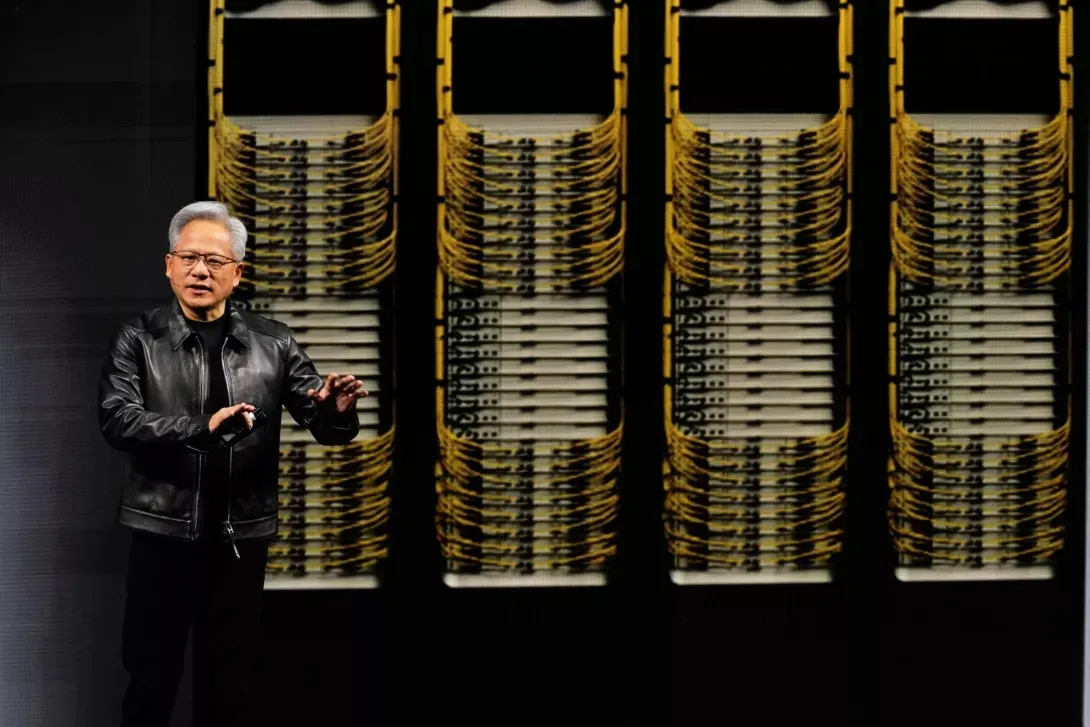
- In just a few years, the US and China have built a new kind of AI empire. Their rule extends beyond physical territory and trade routes into knowledge, capital, and technology.
- What stands out about the Jensen Huang case is that Nvidia’s chips have directly aided China’s AI development, putting the company at odds with the core interests of US closed-source models.
- As a critical node in the contest between AI empires, Taiwan must quickly develop the legal framework and strategic thinking needed to navigate great-power rivalry and to leverage its pivotal position for concrete security guarantees.
Taiwan’s supply chain cannot be replicated elsewhere anytime soon. But in the wake of the Jensen Huang affair, we should pay closer attention to the long-term effects of policy, regulation, and geopolitics.
A recent article in Foreign Affairs – by renowned historian Niall Ferguson, Oxford doctoral candidate Lisa Klaassen, and former Google CEO Eric Schmidt – is a valuable guide for anyone trying to understand two things: the role of global AI competition in the “spygate” scandal surrounding Nvidia founder Jensen Huang and what that competition means for Taiwan.
Ferguson is known for his work on the British Empire and American imperialism, his research spanning international, economic, and financial history. A leading voice of classical liberalism, he was named one of the world’s 100 most influential people by Time in 2004 and was knighted by King Charles for his services to literature in 2024. AI has become the focus of attention for historians like Ferguson, despite it still being an emerging field. In their Foreign Affairs article, Ferguson brings a perspective informed by imperial history while Schmidt brings that of a Silicon Valley insider – outlooks that have helped it attract a broad audience.
Two Rising Imperial Poles
The article opens by placing AI within the framework of imperial history, asserting that today only the US and China qualify as AI empires. Empire here is defined less by territory, armies, and colonies than by control over chips, computing power, energy, data, AI models, and global technology infrastructure.
In just a few years, the US and China have each built this new kind of empire whose reach extends beyond territory and trade routes to knowledge itself. By controlling large language models, chips, infrastructure, and capital, these two countries can bring any country that depends on advanced AI under their sway, with no need for formal alliances or military coercion. This is the new imperial model. Past empires often rose and fell over centuries, but these days the expansion, internal strains, and overextension of AI empires are unfolding at considerable speed.
Unlike the software industry, which once enjoyed near-zero marginal costs of reproduction, AI depends heavily on electricity, critical minerals, advanced chips, and vast amounts of capital. This dependence on resources has recreated the classic imperial structure of the core versus the periphery. At the core, a handful of companies in Silicon Valley and China control the key models and the profits, while countries at the periphery supply raw materials and labor (minerals from the Democratic Republic of the Congo and Indonesia and low-wage data labelers in Kenya and the Philippines) and then buy back the finished products at high prices.
These two AI empires took shape in very different ways. The United States’ grew out of private capital and free markets. It offers cutting-edge technology that is expensive, closed, and subject to export controls. Under the banner of the government initiative Pax Silica, it asks allies to pick a side when it comes to security and supply chains. China’s AI dominance, on the other hand, is the product of state planning. Its open-weight development strategy, for example, emerged from the 13th Five-Year Plan in 2016, rather than coming from the private sector.
Today’s East India Companies
The most intriguing argument in Ferguson’s article compares advanced large language model labs such as Anthropic and OpenAI to the Dutch and British East India Companies of Europe’s imperial age. These AI companies consolidate capital while controlling the talent, data, and models that advanced intelligence requires. But more importantly, they act as arbiters of knowledge, increasingly deciding what humanity can discover, how quickly, and how they eventually use it.
Like the East India companies of the past, the leaders of these AI giants negotiate directly with foreign leaders. They trade model access, computing power allocations, and data center investment for countries’ land, electricity, sovereign capital, and regulatory latitude. Because they can deal directly with political elites, these companies appear to wield something close to sovereign power. Yet the authors point out that they remain subject to their home governments. They must operate within export control regimes and they serve as instruments of their home country’s foreign policy. The Foreign Affairs piece provides a real-world example: in June 2026, the US Department of Commerce ordered a suspension of all foreign nationals’ access to two of the most powerful US models, and within days, those models went offline worldwide.
The US leads in cognitive intelligence (software and advanced models) and in advanced chips, but it struggles to meet energy demands – its aging grid cannot supply enough power and it lacks rare earth minerals. China dominates in physical AI (robotics and manufacturing automation), electricity, and rare earths, but cannot produce the most advanced chips. With each side having its own weaknesses, neither has a decisive edge.
Looking at past empires, the authors note that many fell not to external enemies but under the financial weight of maintaining their dominance. Today, the US relies on the dominance of the dollar and private credit from Wall Street (big tech capital expenditure topped US$600 billion in 2026). China relies on its state banking system and sovereign bonds (it has plans to invest US$295 billion over five years in domestic computing infrastructure).
Ferguson and his co-authors are also deeply concerned that AI hallucinations could misread a situation and prompt leaders to start a war. They cite a Soviet nuclear false alarm from September 1983, at the height of the Cold War. An early-warning radar outside Moscow raised an alert for five incoming intercontinental ballistic missiles, but Lieutenant Colonel Stanislav Petrov, the officer on duty, relied on instinct and professional experience to correctly judge it a false alarm. His prudence earned him renown as “the man who single-handedly saved the world from nuclear war.”
Worried that AI could spark a hot war, the authors recommend that the US and China follow the example of Cold War nuclear arms control talks and establish an “AI détente.” This could include jointly capping model capabilities in high-risk areas such as cyberattacks and bioweapon design, as well as setting safety thresholds for open-source models, to keep this race driven by self-improving machines from spiraling out of control.
Policy and Security under AI Empires
Ferguson’s article gives us a useful perspective from which to look at several recent events. Both empires have sought international support for their AI ambitions. In December 2025, the US State Department initiated Pax Silica, a strategic agreement covering AI supply chain security. Not to be outdone, China has been pushing to become the one that writes the rules of global AI governance. In July 2026, it launched the World Artificial Intelligence Cooperation Organization (WAICO) agreement in Shanghai, with 29 Global South countries as founding members. Since most Global South countries have limited technological and economic muscle, China’s low-cost open-source models are very attractive to emerging markets. China’s AI ambitions follow the same logic as the Belt and Road Initiative – it hopes to align the broader impacts of AI with the interests of the Global South and break free of US geopolitical containment. In the age of AI empires, the standoff between WAICO and Pax Silica resembles the Cold War rivalry between the Warsaw Pact and NATO.
The US is so focused on AI because the technology is already in use on real battlefields. In the Iran war this February, US and Israeli forces launched a surprise attack on Iran. The attack’s potency came less from the destructive force carried by their missiles than from the AI-enabled precision strikes carried out by the US military. For the first time, the world saw what AI looks like in modern warfare.
On the first day of the war, the US military struck more than 1,000 targets in 24 hours, an average of under two minutes per target. Throughout the war, it relied heavily on a military intelligence analysis platform developed by Palantir. The platform pulled together fragmented data collected by multiple agencies, which Anthropic’s Claude then analyzed to identify the best targets. Everything, down to the strike sequence and satellite positioning data, was passed to the operations center, with the system carrying out battle damage assessment in real time. A fighter jet once needed nearly 20 minutes to obtain a ground target’s coordinates, release its munitions, and confirm the target was destroyed. Now the whole process takes under two minutes, a dramatic leap in the tempo of US strikes. The Iran war confirmed for the US just how powerful AI is on the battlefield. Washington is reportedly considering placing AI chips and data centers under permanent, weapons-grade export control provisions in the National Defense Authorization Act.
Jensen Huang’s “Spygate” and the Problem with Operating in a Gray Zone
The hottest topic of late, the Jensen Huang “spygate” affair, can also be understood within the framework of AI empire. Chinese open-source models still need Nvidia chips to be trained. As they close in on US closed-source models, the tectonic plates of the two AI empires have begun to collide, and even Nvidia, the world’s most valuable company, cannot avoid being caught in between.
Whether Alice Huang is a spy is beside the point, and so is the fact that Jensen Huang’s extramarital affairs violated corporate governance standards for a listed company. The real issue is that Nvidia’s chips have directly aided China’s AI development, putting the company at odds with the core interests of US closed-source models. Jensen Huang was forced to shoulder all the blame, and Nvidia can no longer operate in the gray zone of US-China relations. In an interview with Fox News, Treasury Secretary Scott Bessent said that debating whether Alice Huang was a spy was a distraction. More important, he said, was a “culture of non-compliance” at Nvidia, where everyone from senior management down turned a blind eye to illicit sales through shell companies in order to boost revenue and profits.
US controls on AI chip exports mean having to track who the chips are sold to and where they end up. On November 12, former OpenAI researcher Will DePue, now head of the independent research organization Unemployment Labs, published a forensic study that sent shockwaves through the global tech industry and political circles. He developed a technique called “checkpoint forensics,” which analyzes the public weights of open-source AI models to infer which type of GPU was used when a model was initialized. He claims to have found fingerprints of Nvidia’s export-controlled Blackwell architecture in six of the latest models from four of China’s top AI labs: DeepSeek, Moonshot, MiniMax, and Ant Group.
The older models these Chinese labs released before April all pointed to Nvidia’s earlier Hopper (H100) architecture, but the six new models released after April all bore signs of using Blackwell, the later, more advanced architecture. This suggests the embargo on high-end chips has had no meaningful impact on China, which can train models using smuggled chips or offshore data centers. According to research by Epoch AI, between 290,000 and 1.6 million Hopper H100 GPU equivalents were smuggled into China in 2025. At the median estimate of 660,000, about a third of China’s computing power came from smuggling.
Jensen Huang has long argued that rather than abandoning the Chinese market altogether, Nvidia should keep supplying products that comply with export restrictions, preserving the influence of the US technology ecosystem. From a business standpoint, this is not at all unreasonable. China is a major global technology market, and walking away would mean forgoing a large share of potential revenue. The problem is that the US government stopped viewing high-end GPUs as ordinary commercial goods long ago. In the competition between AI powers, Nvidia’s strategic value outweighs its commercial interests.
Nvidia is seen as an irreplaceable asset because, in the eyes of the US national security establishment, advanced computing power is much more than a high-tech product – it is critical infrastructure for AI, military technology, and future strategic competition. This creates a fundamental difference between the interests of companies and the interests of governments. While companies assess the market; governments assess national security. While companies pursue revenue; governments weigh the strategic risks of technology being leaked.
Neither position is necessarily right or wrong, but they can clash. When a corporate leader’s business judgment conflicts with national security policy, does the company have mature enough mechanisms for risk assessment and crisis response or checks and balances on decision-making? A global tech company cannot rely on its CEO’s personal judgment alone to handle strategic issues that have risen to the level of national security. Huang clearly underestimated the political backlash that would follow the news of his affair. Seen through the lens of AI empire, the whole situation gains clarity: a company’s commercial logic crumbles when it runs into national security red lines.
Just days after Huang resigned as CEO of Nvidia, the US Commerce Department’s Bureau of Industry and Security issued new rules tightening controls on offshore data centers and remote access to computing power. Exports or transfers of advanced semiconductors to countries including Indonesia, Malaysia, Singapore, Thailand, and Brazil now require an export license, because these countries are deemed to pose a higher-than-normal risk of technology transshipment. The US is determined to stop China from developing AI through smuggling or offshore computing.
Meanwhile, US President Donald Trump conditionally allowed Nvidia’s H200 chips to be sold to China in 2025, and according to the latest Reuters report, his administration has cleared 900,000 AI chips for export to China this term. Even so, Nvidia’s interim CEO Colette Kress recently announced that the company will no longer sell H200 chips to China.
Huang has been very good to Taiwan’s supply chain. Thanks to this, Taiwan’s mainstream media have been highly sympathetic toward him, framing his ouster as the result of a policy struggle within the Trump administration. In reality, there is broad consensus in Washington political circles about his departure. Republican Representative John Moolenaar stressed that Huang’s dismissal was an unfortunate outcome that could have been avoided. Moolenaar chairs the House Select Committee on Strategic Competition Between the United States and the Chinese Communist Party. He made a statement that US companies should never jeopardize national security by allowing China access to the most advanced chips and that Nvidia must appoint leadership that puts national security first. The Democrats, fresh from a sweeping victory in the midterm elections, have also said they will pursue the matter, demanding that Nvidia preserve records of its decisions on chip exports to China. In fact, the previous Democratic administration under President Joe Biden was stricter on AI chip export bans than Trump’s second administration.
How the AI Imperial Order Affects Taiwan
Taiwan cannot insulate itself from geopolitical risk. It is positioned at the most central node of the entire AI supply chain. TSMC, sitting atop this supply chain, is headquartered just 90 miles from China’s coast, which makes Taiwan the most dangerous flashpoint between the US and China. In Niall Ferguson’s Foreign Affairs piece, he and his co-authors naturally recognize how pivotal Taiwan is to the imperial rivalry between the US and China. The US is pushing TSMC to build fabs in the US, Japan, and Germany to reduce its dependence on Taiwan. But for the perilous window during which Taiwan remains irreplaceable as a chip supplier, the authors urge the US and China to set up channels of communication to avoid an accidental clash that could spark wider conflict.
Huang worked closely with Taiwan’s supply chain, so his departure will certainly have an impact on the country. But that supply chain cannot be replicated elsewhere in the short term. What deserves more of our attention now is the long-term impact of policy, regulation, and geopolitics. Over the past year, the US Congress has drafted four bills targeting chips and computing power (see table). All of them take aim at China, but they will indirectly affect Taiwan as well. Once the four bills are passed, Taiwan’s government and private sector will need to take a comprehensive look at how they will affect industrial development.
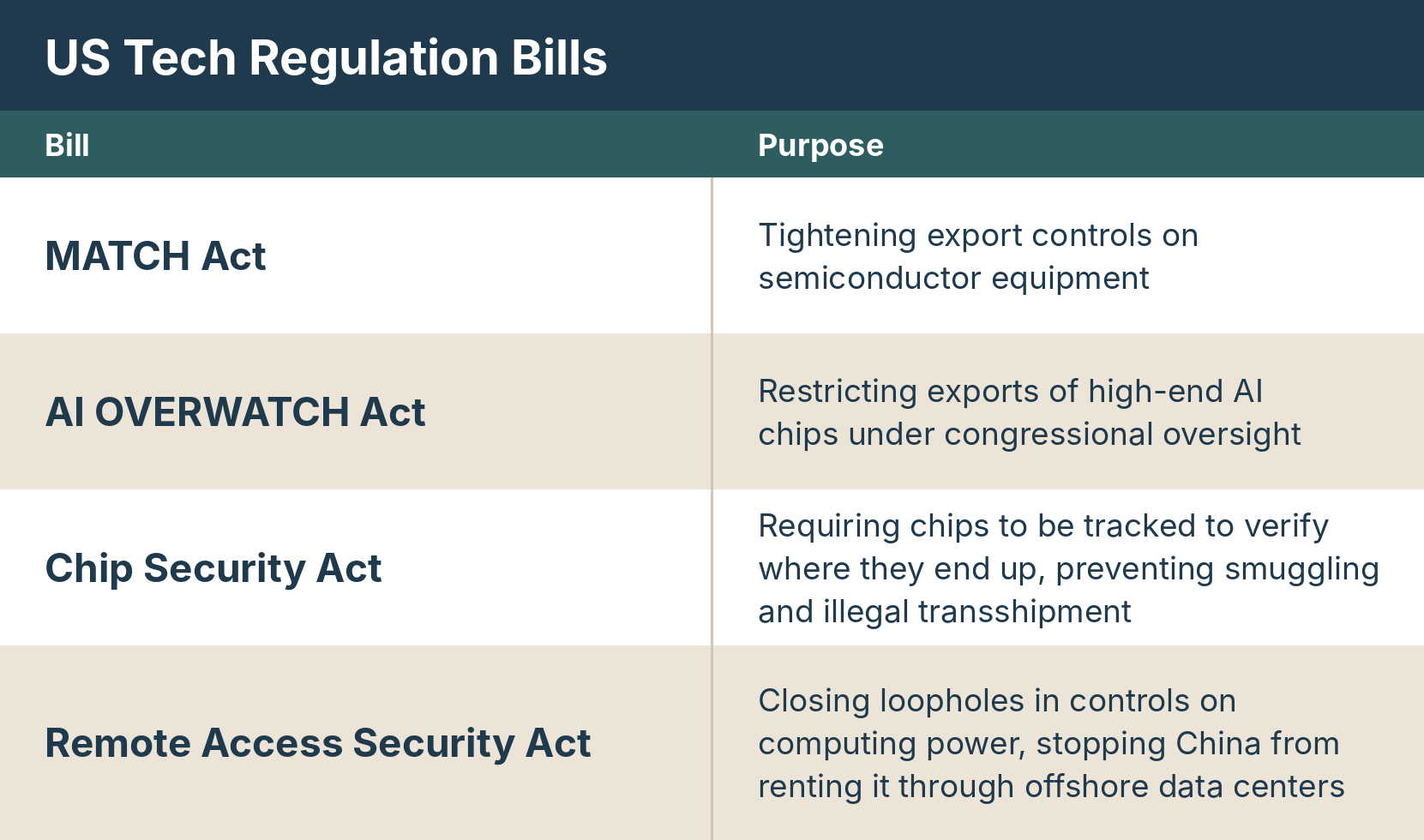
Taiwan makes nearly 85 percent of the world’s AI servers. Nvidia may supply the chips, but it is Taiwan’s system manufacturers that ship the final products. To survive the US-China tug-of-war, Taiwan needs to earn Washington’s trust. Customer due diligence, also known as know-your-customer checks, will fall to Taiwan’s system manufacturers. If even Nvidia, the world’s most valuable company, can get into trouble, there will be no leeway for Taiwanese companies. They cannot take chances for the sake of profit and they have to factor compliance costs into their calculations.
In one example of where Taiwan needs to rethink its approach, its Ministry of Economic Affairs designated 12 types of semiconductor equipment as controlled exports to China back in 2012. In all the years since, the list has contained only those 12 items, and AI servers are not among them. The executive and legislative branches should consider how to amend existing laws or pass new ones to help companies in Taiwan’s supply chain cope with a constantly shifting political environment.
For Taiwan, at the eye of this storm, the old survival formula of separating politics from economics no longer works. Developing a compliance system and strategic thinking equal to the demands of great-power rivalry is now an urgent task. Taiwan is more than an actor bound by others’ rules; it controls the world’s most critical chip manufacturing and system integration nodes. As Taiwan’s government and industry cooperate with US export controls, they should also consider how to turn their irreplaceable strategic value into more concrete security guarantees, trade agreements, or leverage for technology cooperation, rather than passively absorbing the spillover risks of unilateral US legislation (such as the bills in the table above). That is the strategic question that Taiwan’s decision makers should give more thought.