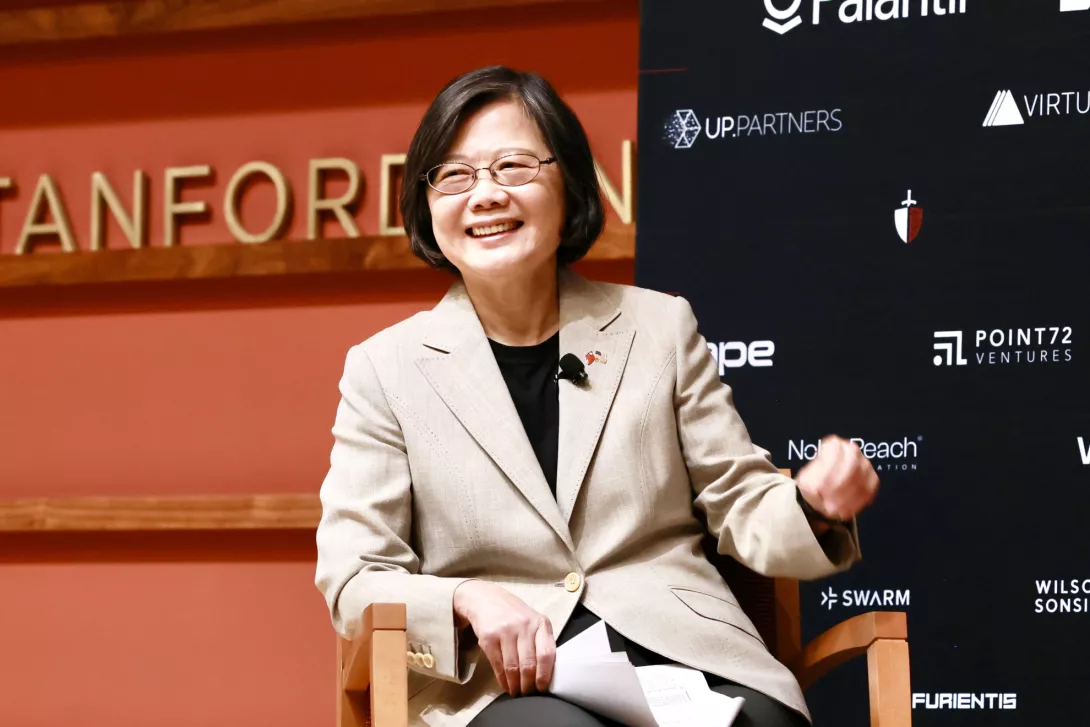
In this speech at Stanford DEFCON, former President Tsai Ing-wen discusses Taiwan's evolving security challenges and the importance of strengthening deterrence through defense modernization, technological innovation, and societal resilience. Drawing on Taiwan's experience, she highlights the country's industrial and technological capabilities and explores how Taiwan and its democratic partners can build together to strengthen collective security and resilience.(Video clip1) (Video clip2)
It is a great pleasure to be here at Stanford University. I want to start by thanking the student organizers from Stanford DEFCON for the invitation.
A gathering of this sort, that brings together students, investors, people from industry, and members of the policy community, would have been much harder a decade ago and most likely impossible when I was a graduate student.
But today, these different groups are discussing the same questions about technology, security, and the future.
The challenges we face no longer fit into separate categories. Technology is now inseparable from national security, and economic resilience depends on supply chains, industrial capability, and access to critical technologies. Issues that were once dealt with largely by governments now require much broader participation from industry, researchers, investors, and civil society.
In other words, how we preserve peace in an Indo-Pacific where military power, technology, economic security, and democratic resilience intersect, is one of the most important questions before us today.
A Changing Security Environment
We are now facing a security environment very different from even a few years ago.
Russia's invasion of Ukraine has reminded us that major war remains possible, even in a world of deep economic ties. Recent conflicts have also demonstrated how quickly sophisticated weapons can be consumed, and how much longer it can take to replace them.
At the same time, technology is changing the nature of security competition. Artificial intelligence, autonomous systems, drones, cyber capabilities, and communications technologies are developing at a pace that traditional procurement and government decision-making struggle to match.
For democracies, resolve, resources, and sound strategy remain essential. But they are no longer enough on their own. Security increasingly depends on whether we can translate those commitments into real capabilities, and how quickly we can do it.
Taiwan's Security Challenge
This challenge is particularly immediate for Taiwan.
We face daily cyberattacks, cognitive warfare, information manipulation, economic coercion, and attempts to compromise our critical infrastructure. Chinese military aircraft and vessels also operate around Taiwan on a regular basis, while coast guard and other activities have become increasingly common around our waters.
These activities rarely rise to the level of open conflict by design. Gray-zone activities are intended to impose costs, test our responses, and gradually alter the security environment around Taiwan, while avoiding the political and military consequences of an open confrontation.
For Taiwan, maintaining peace therefore requires more than preparing for a major military contingency. We have to respond to sustained pressure in ways that preserve our own confidence and freedom of action, while continuing to strengthen our capacity to defend ourselves should deterrence fail.
There is also a larger regional dimension.
The Taiwan Strait is one of the world's most important trade and energy routes, and Taiwan is deeply integrated into global technology and manufacturing networks. A serious disruption would be felt throughout the Indo-Pacific and beyond.
Preparing for More Than One Contingency
In making us prepared for possible challenges across the Taiwan Strait, there was considerable debate over the balance between conventional military capabilities and smaller, more mobile and distributed systems.
Admiral Lee Hsi-min, who is here today, was among those who argued most forcefully for a greater emphasis on asymmetric defense.
Many of those ideas have since become much more widely accepted, and they have influenced how Taiwan thinks about its defense.
A democracy under sustained pressure cannot prepare for only one contingency. It has to manage several forms of risk at the same time.
For the possibility of a major conflict, Admiral Lee is right that Taiwan needs a large number of small, survivable, and distributed systems that can continue operating even under attack.
At the same time, Taiwan must also manage persistent pressure below the threshold of open conflict.
Those challenges require different kinds of responses. Gray-zone pressure cannot always be answered with capabilities designed primarily for wartime. It requires presence, surveillance, readiness, and the ability to demonstrate that Taiwan continues to function normally despite the pressure around us.
Governments rarely have the luxury of choosing the security environment they would prefer to prepare for.
Difficult Decisions
Some of the decisions required to bolster our security were also politically difficult.
In December 2022, my government announced that mandatory military service, that is conscription, would be extended from four months to a year.
The decision came shortly after difficult local elections, which my party lost, a lot, but still I had to make a decision and the political cost is very evident.
Even so, we believed the reform was necessary because Taiwan had to demonstrate a credible and sustained commitment to its own defense.
Extending military service was never simply about keeping young people in uniform for a longer period of time. It was accompanied by better facilities, modern equipment, and more realistic training, giving those who serve a more serious and worthwhile experience.
The same resolve was required for a different kind of decision, that is whether Taiwan should develop the capacity to build at home what it had never built before.
In our case, that decision was the Indigenous Defense Submarine program.
What gave us confidence was Taiwan's established record in developing and managing complex technologies and translating them into reliable manufacturing. After weighing all the factors, we concluded that Taiwan had both a clear strategic need and the industrial capacity to proceed.
The results of that decision and determination are now becoming visible almost two years after I left office.
Hai Kun, Taiwan's first domestically built submarine, has completed 17 submerged sea trials, and is nearing the completion of its testing. That means we are going to have a submarine soon.
That program reinforced the importance of preserving the engineering skills and industrial capacity that allow Taiwan to take on greater responsibility for its own security when external supply cannot always be taken for granted.
Deterrence Is More Than Military Power
Our experience has also taught us that hardware and military capability are only one part of deterrence.
A society under pressure must still be able to function, with communications, energy, hospitals, public services, and access to reliable information all remaining resilient.
During my presidency, we began treating cybersecurity as a national security issue, invested in civil resilience, and worked with civil society to respond to information manipulation. We also came to understand that public trust is itself a form of infrastructure that must be maintained before a crisis occurs.
This matters because authoritarian interference often tries to exploit the openness of democratic societies. Even the most sophisticated military systems cannot compensate for weak institutions, disrupted critical services, or a loss of public confidence.
Deterrence, in other words, is a property of an entire nation, not only of its military.
What Taiwan Brings
Today, many international headlines still discuss Taiwan as a security challenge and requiring support from others. That is only a part of the picture.
Taiwan is among the small number of democracies able to add manufacturing capacity to this problem, rather than only consuming it.
Our semiconductor industry is the best-known example, but its significance is worth looking at in broader terms.
For example, the United States hosts about three-quarters of the world's AI computing capacity, while nearly all of the advanced accelerators used in those systems are fabricated by Taiwanese firms. Around nine in ten of the AI servers built around those chips are also produced by Taiwanese companies.
The AI economy, therefore, depends heavily on what Taiwan builds, and our contribution extends well beyond semiconductors.
This is to say, artificial intelligence rests on a much broader industrial foundation, including advanced manufacturing equipment and materials, servers, communications infrastructure, cooling and power systems, and a wide range of specialized components.
Taiwanese companies are deeply involved across many parts of this ecosystem.
Satellites offer another example. The industry is expanding at extraordinary speed, and Taiwanese firms are already important producers of radio-frequency chips and circuit boards that are essential to communications and satellite systems.
These same capabilities are directly relevant to security, because the distinction between civilian and defense technology has become much less clear.
The Importance of Industrial Capacity
However, advanced technology has little strategic value if it cannot be produced in sufficient quantities, modified as requirements change, and delivered when it is needed.
Weapons systems can now evolve significantly within a matter of months. Taiwan's industrial system has spent decades developing precisely this capability.
We saw what that capacity meant during the COVID pandemic.
In early 2020, Taiwan could not produce enough surgical masks for our own population. More than 80 machine-tool companies came together to build 92 production lines in less than 40 days, making Taiwan one of the world's largest producers of surgical masks.
What mattered here is not the number of masks, it is how quickly Taiwan's industrial ecosystem responded once government, companies, engineers, and suppliers shared a clear objective.
That adaptability is exactly what many of the technologies shaping our future security now demand.
Our experience has been to use industrial capability in ways that strengthen partnerships, whether it is helping international partners during the pandemic or contributing to more resilient technology and manufacturing networks.
Therefore, our collective objective should be to build networks in which democracies contribute the capabilities they possess, reduce dangerous dependencies, and retain enough collective capacity to respond when supply chains are disrupted or security conditions change.
In some areas, Taiwan is indispensable to making that network function.
Drones and Autonomous Systems
Let us take drones as an example.
Drones are one area where Taiwan's industrial base is already highly relevant. More than 200 Taiwanese companies are now involved in the sector, while many of the components that constrain global production, such as controllers, motors, cameras, and other electronics, are precisely the products Taiwan already knows how to manufacture at scale.
Taiwan is also well positioned in the electronics needed to counter drones.
Jammers, radars, and other counter-drone systems depend on specialized chips, and Taiwan already has globally competitive producers in these technologies, giving Taiwan the manufacturing base to turn allied designs into trusted systems at volume.
The same applies to the intelligence inside autonomous systems.
Taiwan produces more than 90 percent of the world's AI servers, while its chip designers already also supply the vision and processing modules that allow drones to navigate, identify targets, and continue operating when radio links or satellite signals are jammed.
At sea, Taiwan can contribute to the next generation of unmanned vessels.
Taiwan already ranks among the world's leading builders of large yachts and is home to two of the ten largest container shipping lines, giving it both shipbuilding expertise and deep commercial maritime experience.
Those capabilities provide a strong foundation for developing unmanned vessels that can support sea denial, while also keeping essential supplies moving during a crisis.
Taiwan's Place in the Region
The same logic applies to our place in the region.
Taiwan is located at the center of the first island chain, and at the same time, Taiwan is a major participant in the global technology economy.
This combination of geography, democracy, technology, and industrial capacity gives Taiwan a role that few countries can replicate.
A secure and resilient Taiwan contributes to a more stable Indo-Pacific, while its technological and industrial strengths reinforce trusted supply chains and reduce vulnerabilities far beyond the region.
Having benefited greatly from the international system, Taiwan now has both the capacity and responsibility to contribute more to its resilience.
Re-industrialization is work that democracies must undertake together, and Taiwan should be understood as part of that broader effort to strengthen the capacity and resilience of the democratic world.
Building Security Together
Very few democratic countries in the world can offer what Taiwan brings, and in some areas, there is simply no substitute.
Taiwan has the combination of advanced manufacturing, accumulated process knowledge, engineering talent, dense electronics supply chains, and the ability to take complex designs and produce them reliably at speed and at scale.
These are capabilities built over decades and deeply embedded in an industrial ecosystem that cannot be recreated simply by constructing new factories.
This is why building together, combining our respective strengths to create the capabilities that our shared security increasingly requires should be the future.
For those seeking to strengthen technological, industrial, and security resilience, Taiwan is therefore not simply a useful partner; it is an indispensable one.
Now, many of you in this room will help shape what is built, where it is built, and with whom.
Those decisions will affect not only markets and technology, but also the security environment in which our societies operate.
Deeper cooperation with Taiwan therefore strengthens not only Taiwan's own security, but also the stability of the Indo-Pacific and the resilience of the wider democratic community.
I would like to thank the Gordian Knot Center for hosting this conference, and especially the students who have worked to bring us together today.
Thank you very much.
Keynote Speech delievered at the 4th Annual Stanford Conference on Tech+National Security (DEFCON) on October 7, 2026. Stanford DEFCON is a student-led initiative that convenes leaders from government, academia, and industry to discuss emerging technologies, national security, and strategic competition.