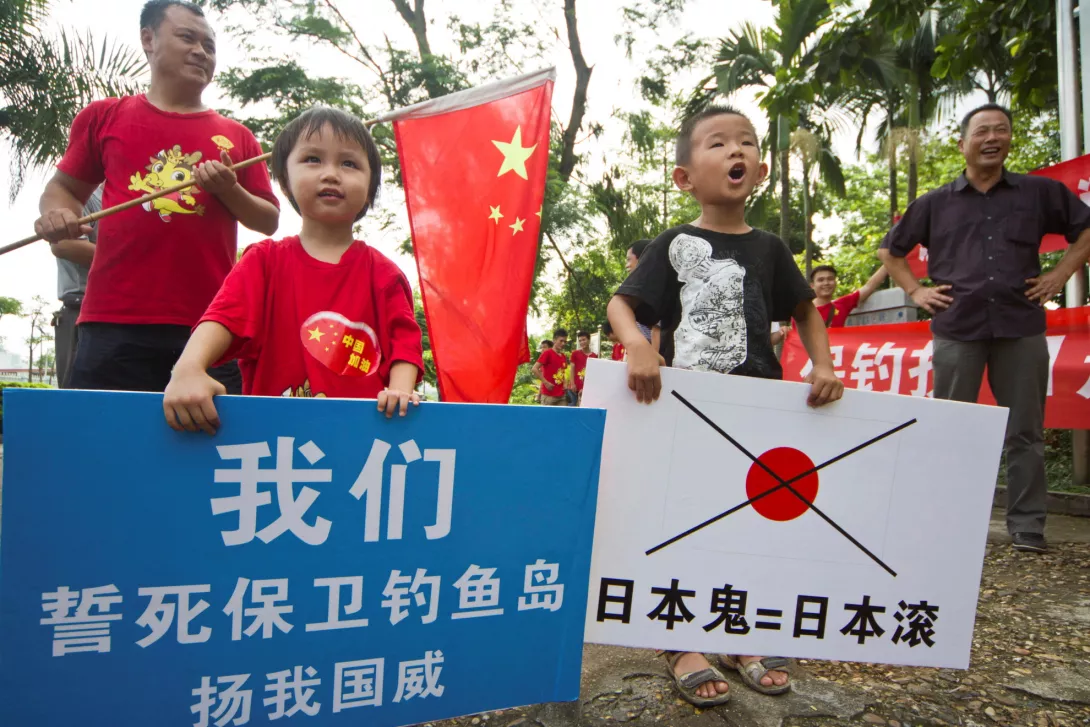
- Beijing does not simply encourage anti-Japan nationalism; it carefully regulates when and how that sentiment can be expressed, mobilizing historical grievances while preventing public anger from escaping state control.
- The limits Beijing places on anti-Japan sentiment reflect both economic pragmatism and a widening divide between official rhetoric and Chinese society's continued engagement with Japanese business, culture, and consumer life.
- The party's greatest concern is that nationalism could eventually break free of this narrative and begin choosing its own enemies and writing its own version of Chinese history.
When Japanese Prime Minister Sanae Takaichi spoke in the Diet about a "Taiwan contingency," Beijing answered with a succession of hardline measures, including rare-earth export controls and tourism restrictions. Its central narrative has changed little since the 2012 "nationalization of the Senkaku/Diaoyu Islands": Japan is again portrayed through its history of militarism and aggression, as if the brief thaw in Sino-Japanese relations around 2018 had never taken place.
The 2012 nationalization dispute set off large-scale riots targeting Japanese consulates and businesses. Nothing comparable has occurred since, even when anti-Japan rhetoric has intensified. The contrast is revealing. China's leaders routinely summon memories of war, but they pull back whenever public anger approaches the limits of state control. Beijing's Japan policy therefore combines hardline posturing with deliberate restraint. The more revealing question is not simply why Beijing promotes anti-Japan sentiment, but why it never allows that sentiment to run its full course.
Anti-Japan Sentiment Must Be Measured: Beijing's Management of Nationalism
If Chinese nationalism is treated simply as an uncontrolled surge of public opinion, much of Beijing's behavior becomes difficult to explain. The authorities do not merely follow nationalist sentiment; they actively manage it. Several recent episodes reveal the political logic behind that management.
The December 2025 National Memorial Ceremony for the Nanjing Massacre offers one example. In the wake of Prime Minister Takaichi's remarks on a "Taiwan contingency," many expected Xi Jinping to deliver the address himself. Instead, Politburo member Shi Taifeng attended, and his remarks were notably milder than anticipated. The unusually subdued ceremony lasted only half an hour. Xinhua's subsequent coverage also broke with the past practice of denouncing Japan as an aggressor.
The same pattern appeared a month earlier. In November 2025, Masaaki Kanai, Director-General of the Asian and Oceanian Affairs Bureau at Japan's Ministry of Foreign Affairs, met Liu Jinsong, Director-General of the Department of Asian Affairs at China's Ministry of Foreign Affairs. Beijing deliberately released photographs that showed the Japanese delegation bowing and listening while Liu lectured with his hands in his pockets—a carefully staged image meant to define the terms of the relationship. Yet Liu later traveled to Liaoning Province to reassure Japanese companies that "you may operate in China with confidence." After an inspection visit, he even embraced his counterparts in a conspicuous display of warmth.
Beijing applies the same management to popular culture. In July 2025, China's National Radio and Television Administration issued guidance on "short dramas depicting the War of Resistance," prohibiting the exaggerated and sensationalized productions known as "anti-Japan idol dramas." Beijing needs the memory of resistance to Japan; it does not need that memory to generate uncontrolled hostility.
The official response to the June 2024 stabbing at a Japanese school in Suzhou followed a similar logic. Hu Youping, a Chinese teacher accompanying the children, was killed while trying to protect them. The government subsequently honored her as a "National Hero for Righteous Courage," shifting public attention away from the idea that "the Japanese deserved to die."
These episodes span diplomacy, culture, history, and society, but they all point to the same conclusion. Beijing has neither abandoned anti-Japan sentiment nor surrendered control over it. Chinese nationalism is not a flood allowed to run wild. It is closer to a canal whose course has been painstakingly engineered by the state.
Two Coexisting Narratives: A History of Aggression and the Allure of Japanese Culture
A canal that requires constant reinforcement is not flowing as its designers intended. If nationalism, and the anti-Japan sentiment it produces, were merely an instrument of diplomacy, Beijing would not need to regulate it so carefully. The stakes go beyond changes in the international environment. The party is also confronting a much more difficult domestic challenge.
Throughout history, when an old order has begun to loosen, the gravest threat to those in power has rarely come from abroad. It has come from the need to answer two questions from within: "Who are we?" and "Where are we headed?" Kemal Atatürk forged modern Turkey from the remains of an empire; the Meiji government remade the Japanese nation-state after the arrival of the "Black Ships." Beijing is now using the idea of a "Chinese national community" to explain how the nation was formed and why it must remain unified. Japan has consequently become an indispensable reference point in the construction of "China's story." In Beijing's grand historical narrative, the War of Resistance against Japan becomes a shared experience in which Han, Manchu, Mongol, and Hui peoples all suffered and then resisted a common foreign enemy.
Chinese society, however, does not always follow the official script. Since late 2025, political pressure has led to the cancellation of concerts in China by Japanese artists including ONE OK ROCK and Ayumi Hamasaki. Yet concerts are expensive and undergo careful evaluation long before they reach the stage. The fact that these performances were planned at all, even if they were later canceled, amounts to a quiet vote in favor of Japanese culture. At Shanghai's 2026 "Sino-Japanese Friendship Coming-of-Age Ceremony," more Chinese students wore kimono than the year before, despite pressure from officials and universities. Nor did heightened rhetoric over the "Taiwan contingency" prevent the Japanese restaurant chain Sushiro from expanding substantially in China. In the fourth quarter of 2025, the company reported a 54.4 percent year-on-year increase in overseas revenue.
Official hostility has therefore not produced a corresponding retreat from Japan in Chinese social life. People continue to listen to the music of a "hostile nation," wear furisode, and enjoy Japanese food. Japan now occupies two narratives at once: the history of aggression recited by the state and the cultural attraction experienced directly by the public. This divergence makes the "anti-Japan community" that Beijing seeks to build increasingly unstable. What the authorities must manage is not Japan alone, but the widening distance between these narratives, and what that distance means for how Chinese people understand themselves and the history of Sino-Japanese relations.
Beijing's Deepest Fear: Nationalism Beyond Its Control
For Beijing, the gap between the official narrative and society's response raises the possibility that nationalism could escape its carefully engineered channel. This produces two related anxieties. Does the public still believe that the "China Dream" will ultimately be realized? And who, in the end, holds the pen that writes "China's story"?
When the Senkaku/Diaoyu Islands were "nationalized" in 2012, China's economy was advancing rapidly and unstoppably. Society could still absorb the disruption and costs generated by nationalist mobilization. Today's economic downturn has changed that calculation. Driving away foreign capital would damage the economy, but the greater danger is political: public confidence in the "China Dream" ultimately rests on economic performance. If growth stalls, accumulated grievances could quickly be redirected toward Beijing itself.
The investment figures sit uneasily beside the familiar image of strained Sino-Japanese relations. According to China's Ministry of Commerce, Japanese investment in China rose 55.5 percent year-on-year during the first three quarters of 2025. Figures from the Japanese Chamber of Commerce and Industry in China indicated that, in 2026, 59 percent of Japanese companies planned either to expand their investment or maintain it at its current level. The figures capture the practical advantage Beijing gains from being loudly anti-Japan while remaining restrained in practice.
Even as Beijing tries to weave a coherent "China's story," an interpretation it deeply fears has emerged: the "1644 view of history." Its proponents trace modern China's weakness and humiliation to the Manchu conquest of 1644 and the subsequent rule of an "alien" ethnic group, which they argue brought about the wholesale collapse of Chinese civilization. This view may remain confined to a minority, but it poses questions that Beijing cannot easily answer. Why condemn the Nanjing Massacre while saying nothing about the "Ten Days at Yangzhou," carried out by another foreign people? Were Xinjiang, Tibet, Mongolia, and the Northeast, regions once ruled by other, even "foreign," peoples, really "sacred and inseparable Chinese territory since ancient times"? And once the "1644 view of history" has taken hold, what other "subversive ideas" might quietly follow?
Once nationalists claim the authority to interpret history for themselves, they challenge far more than established territorial and ethnic boundaries. They challenge the entire narrative of victimhood, resistance, and the "great rejuvenation of the Chinese nation." A children's parade held in Vladivostok, Russia, in May 2026 illustrates the problem. The event commemorated victory in World War II and included elementary school students from China. Yet Vladivostok was once Qing territory, ceded to Russia under the 1860 Treaty of Peking. Its Russian name means "ruler of the East" or literally, "to conquer the East." The parade was therefore likely to awaken another memory of invasion and territorial loss in modern Chinese history. Chinese authorities subsequently deleted nearly all reports of it.
The implication is difficult to avoid: when the public asks who invaded and brutalized China, Japan is not the only possible answer. Beijing's deepest fear is that once historical memory has been awakened, the ruling authorities may no longer be able to decide where nationalism begins and ends.
Why Anti-Japan Sentiment Works: External Pressure and Internal Mobilization
We can now return to the question with which this article began. Are Beijing's hardline measures against Prime Minister Takaichi and the Japanese government intended to apply external pressure or mobilize the public at home? They do both. Observers simply tend to notice the external function while overlooking the domestic one.
Anti-Japan sentiment helps Beijing construct China, but the party cannot permit it to develop on its own terms. A nationalism that acquires the power to define "what China is" could eventually challenge the legitimacy of the regime itself. Chinese nationalism must therefore be understood first as an instrument of domestic governance, and only then as a tool of foreign policy.
The anti-Japan narrative is valuable precisely because it supplies a shared memory of victimhood that crosses regional and ethnic lines. Han, Manchu, Mongol, Hui, and other groups can all be incorporated into a story of "jointly resisting foreign aggression." Beijing can thus recast a multi-ethnic state as a single community of shared destiny. In doing so, it offers answers to three fundamental questions: who counts as Chinese, what China is, and why it must remain unified.
This project requires an external object that can carry collective memory and consolidate public identity. The United States is ill-suited to that role. At a time when Beijing and Washington must manage their rivalry, mobilizing anti-American nationalism would be too costly. Japan offers a safer alternative. Sino-Japanese relations contain a deep reservoir of historical memory—enough to generate an emotional response without destabilizing the broader dynamics of US-China rivalry. That makes Japan an ideal vehicle for Beijing's narrative.
Japan is therefore not the only source material available for Beijing's nationalism, but it is the easiest to mobilize and control. A nationalism useful to the party must accept the enemy designated by the state, the history selected by the state, and the memory of victimhood sanctioned by the state. Otherwise, Beijing risks losing more than control over foreign policy; it risks losing the authority to define Chinese identity itself. The party has never truly feared that nationalism will fail to mobilize the public. It fears that nationalism will choose its own enemies—and write a different version of "China's story."
(Translated by Ketty W. Chen)