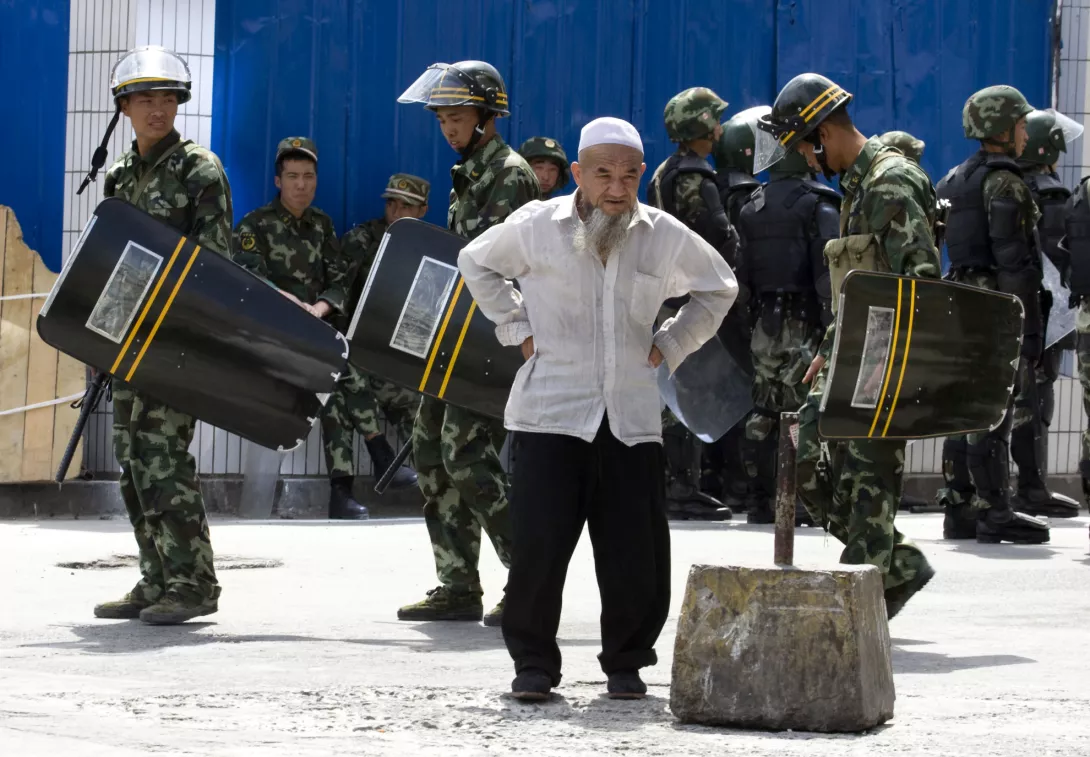
- In law and institutions, the Chinese Communist Party (CCP) is advancing toward the goal of a thoroughly unitary nation-state. For ethnic minorities, this represents an entirely new form of extreme Chinese imperialism.
- The Law on the Promotion of Ethnic Unity and Progress (the "Law") is a rigid governance technology for dissolving the subjectivity of ethnic minorities, encompassing methods such as demographic dilution, elite co-optation, economic control, and the reshaping of historical narratives.
- Since taking office, Xi Jinping has advanced the externally oriented Belt and Road Initiative alongside the internally oriented Law, raising the question of whether this marks the beginning of a "New Tianxia Centered Inperial Order."
On July 1, 2026, China formally implemented the Law on the Promotion of Ethnic Unity and Progress (hereafter, "the Law"). The Law's entry into force marks the completion of a historic turning point: in law and in institutions, the CCP has fully abandoned the Leninist doctrine of "national self-determination" that it championed in its founding years, and has instead established a framework for racial and cultural assimilation built on a Han Chinese template, advancing toward the goal of a thoroughly unitary nation-state. For ethnic minorities, this is an entirely new form of extreme Chinese imperialism, one that goes beyond the classical multi-ethnic empire.
"Forging a Firm Sense of Community for the Chinese Nation"
This nearly century-long legal shift takes on particular significance when set against the CCP's early revolutionary history. During Long March in 1935, the Red Army established the Jiarong Soviet and the Gêleđêsha Republic in what is now the Tibetan area of northwestern Sichuan. In order to build material and political trust, Mao Zedong and other leaders deliberately issued IOUs when requisitioning grain from local communities. Mao said at the time that the Red Army was standing on the territory of an ethnic minority, and that the grain constituted the "first foreign debt" owed by the Chinese Soviet Republic.
In that revolutionary era, when the goal was to overthrow the old regime, treating ethnic minority regions as equal political entities, and even recognizing their right to freely secede and found independent states, marked the high point of the CCP's wholesale embrace of Lenin's theory of national self-determination. Yet once the state was successfully founded, every inch of territory became a sacred and inseparable part of it.
The Law now in force establishes "forging a firm sense of community for the Chinese nation" as its highest statutory principle. The territory of the former Jiarong Soviet has long since become the People's Republic of China's Aba Qiang Autonomous Prefecture, which will now be fully absorbed into a single national identity and institutional order.
In addition, The Law repeatedly appropriates the language of Fei Xiaotong's 1988 thesis on "the pattern of diversity within unity of the Chinese nation," while fundamentally recasting its meaning.
Fei's original argument held that the formation of the "Chinese nation" was a natural, dialectical process of coalescence through prolonged historical interaction, moving from being "in-itself" to being "for-itself."
By contrast, today's legal text recasts this process as a deliberate project of "conscious," or "for-itself," assimilation, driven by Han-centered institutional power. Under the post-Soviet paranoia, or pretext, that "external forces are seeking to divide China," it seeks to remake society through administrative planning, fiscal budgeting, and other instruments of governance.
The aim is to forcibly reformat the "in-itself" way of life of ethnic minorities (as individuals) into a state-sanctioned "conscious compliance," while ensuring that ethnic minorities (as a collective) are gradually absorbed into, and disappear within, the dominant Han nationality.
This transformation absorbs a move made more than two decades ago by core Chinese policy intellectuals such as Ma Rong, who appropriated the discourse of "ethnic group" (zuqun 族群) that had emerged in Taiwanese academia during the period of political localization. The effect is to strip ethnic minorities of political boundaries and demote them to purely private-sphere cultural symbols.
From a strategic standpoint, many of the administrative measures that preceded this legislation have already accumulated years of practical experience, including cultural-cleansing measures such as the re-education camps of East Turkestan (Xinjiang) and the boarding schools of Tibet (Xizang), both implemented for years before any law was enacted.
What the legislation does is codify that accumulated experience: tactical outcomes are now clarified into strategic objectives, providing a complete legal foundation for expanding and normalizing the sophisticated social engineering that has been carried out in recent years in the so-called "ethnic regions."
Six Major Strategies for Dissolving the Subjectivity of Ethnic Minorities
This rigid governance technology for dissolving the subjectivity of ethnic minorities manifests concretely in six interlocking strategies:
The first is demographic dilution. Leveraging the sheer population size of the dominant ethnic group, the state systematically channels capital, technology, and managerial cadres into the borderlands or so-called "ethnic regions," while at the same time directing labor from those regions toward the higher-wage interior (Han areas), diluting the geographic concentration of ethnic minorities (as set out in Articles 24, 25, and 26 of the Law).
Second is community embedding. Through the grassroots social governance emphasized in Articles 22 and 23 of the Law, residential planning, from villages to cities, breaks down the existing boundaries of ethnic settlement and forcibly promotes an embedded, mixed-residence pattern with Han Chinese. This compresses the space available for collective cultural self-defense, and ultimately leaves territorially based ethnic autonomy with nothing to anchor it.
Third is economic constraint. Chapter Four of the Law, on "common prosperity," subordinates economic planning goals for ethnic regions to the goal of ethnic assimilation, using a nationwide "great circulation" to build a development model of dependency, one that produces deep dependence, at the local, collective, and individual levels alike, on the will of the state.
Fourth is elite co-optation. Article 49 emphasizes the cultivation of ethnic-minority cadres. Together with the previously noted provisions encouraging entrepreneurship in the interior, it draws locally influential elites into the institutional track, offering them political advancement and economic dividends.
As these elites are drawn away from their home regions, local society is deprived of the very nucleus around which collective resistance might otherwise cohere.
Fifth is forced language shift. Article 15 mandates the comprehensive implementation of Mandarin-language instruction and public use, effectively marginalizing minority languages and severing the umbilical cord between the next generation and their mother tongue and cultural matrix. Mandarin Chinese, repackaged under the neutral-sounding label of "Putonghua 普通話" or "Standard Mandarin", is poised to become the mother tongue of the next generation across all ethnic groups.
Last is the reshaping of historical narrative. Chapter Two declares the goal of "constructing a shared spiritual homeland." The authorities are comprehensively rewriting historical narratives, redirecting ethnic minorities' historical consciousness toward a collective memory constructed around, and merged with, the Han as the central subject. Past ethnic tensions are reinterpreted as fraternal contradictions internal to the Chinese nation, extinguishing any independent imagination of a separate historical subjectivity.
The Beginning of a "new Tianxia-centered imperial order"?
In the late Qing Empire, millennia-old notions of "Tianxia-China 天下-中國" were shattered by Western powers. Scholars such as Liang Qichao and Gu Jiegang began constructing, or reflecting on, what the "Chinese nation" (Zhonghua minzu 中華民族) actually was.
A modern form of nationalism was born in China amid a cacophony of competing ideas, emerging from the ruins of the fallen Celestial Empire, or Tianchao. Liang Qichao grappled with the modernizing challenge of transforming imperial "subjects" into national "citizens." Gu Jiegang turned to ancient history to deconstruct the essentialist myth of a "Greater China" and sought instead to understand the nation as a negotiated political construct. Sun Yat-sen, then moved from a resistance-based and racialized form of anti-Manchu nationalism to a Han-centered vision of "Five Races Under One Republic" after the founding of the state.
The CCP, for its part, moved from its early revolutionary Leninist positions of class revolution and national liberation, gradually abandoning national self-determination as its fortunes improved, and turning instead toward a form of sham ethnic autonomy governed by the Party. Fei Xiaotong's theory of "diversity within unity" rationalized the tension between nominal ethnic autonomy and the imagined unitary nation.
This entire sequence of processes shaped the face of modern Chinese nationalism, whose overall tendency has been toward unification, without being able (or willing) to shed its internal diversity.
Since the year 2000, against the backdrop of China's rising national power and generally favorable conditions, Chinese intellectual circles began new thinking along this path. Just as Ma Rong was proposing to replace "nationality" (minzu) with "ethnic group" (zuqun), Zhao Tingyang published "The Tianxia System: An Introduction to Philosophy of World Policy", arguing for a "Tianxia" order to replace the sovereign-state order that had prevailed since the Peace of Westphalia.
This argument later sparked intense debate among Chinese scholars. Although it was framed as political philosophy, "Tianxia" has always been inseparable from the idea of China as the Celestial Empire, or Tianchao, at the center of the world order. Any Tianxia order must therefore confront a fundamental question: who governs it? Without an answer, it is little more than utopian rhetoric. Scholars such as Ge Zhaoguang saw this danger clearly and questioned whether the new "Tianxia" discourse was truly a vision of world order, or simply a new imperial imagination.
Talk of "Neo-Tianxiaism" fell quiet for a long time, but since Xi Jinping took office, China's sweeping external push through the Belt and Road Initiative has inevitably raised suspicions that it may be some form of Neo-Tianxiaist practice. Now, the domestic implementation of the Law formally declares the establishment of a "Greater Han chauvinist Chinese nationalism" that erases diversity.
The multi-ethnic empire built by the Manchu Qing is now entering the final stage of its transformation into a unitary Chinese nation-state. This process is unfolding openly, smoothly, and without restraint. It reveals, in full, the extreme imperial logic of China's internal colonialism.
This new form of empire is rare in history. While much of the world's attention today is focused on China's transnational repression, the deeper question may be: are we witnessing the beginning of China's transition toward a new Tianxia-centered imperial order?