In late April 2026, Taiwan President Lai Ching-te was scheduled to conduct a diplomatic visit to the Kingdom of Eswatini to commemorate the 40th anniversary of the coronation of King Mswati III. The visit would have marked Lai's first official visit as president to Africa. However, the day before Lai's scheduled departure, Secretary-General to the President Pan Men-an announced that Taipei had canceled the trip because Mauritius, Seychelles, and Madagascar had each revoked permission for Lai's plane to fly through their airspace. To further complicate the issue, Germany and Czechia each reportedly denied Lai permission to land and refuel in their countries as an alternate route, out of fear of the effect on their relationships with Beijing.
While these countries' landmasses are small, they have large flight information regions spanning a significant portion of the Indian Ocean and were able to prevent Lai from traveling easily from Taipei to Eswatini. Pan credited their decisions to "intense pressure from the authorities in China, including economic coercion." Foreign Minister Lin Chia-lung attended the festivities in Lai's place, and Lai himself shocked the world by arriving unannounced in Eswatini on May 2. Everything in the end seemed to work out, but the incident is still worth analyzing in order to understand its long-term implications for Taiwan.
Closing airspace to a leader traveling abroad is not without precedent. Lithuania, Latvia, and Estonia each forbade Slovak Prime Minister Robert Fico from flying over their countries to visit Moscow for the 2026 Victory Day parade. They made the decision themselves, without coercion by another country. As Pan noted in the Africa example, "Using coercive tactics to force third countries to alter their sovereign decisions is without precedent in the international community." This appears to be the first example of a third party coercing multiple countries into making such a norm-changing decision.
For Taiwan, it is just another way that Beijing has utilized an all-of-society coercion toolkit to prevent Taipei from conducting its international relations. What do the decisions by Mauritius, Seychelles, Madagascar, Germany, and Czechia mean for Taiwan?
Setting the Aerial Agenda through the United Nations
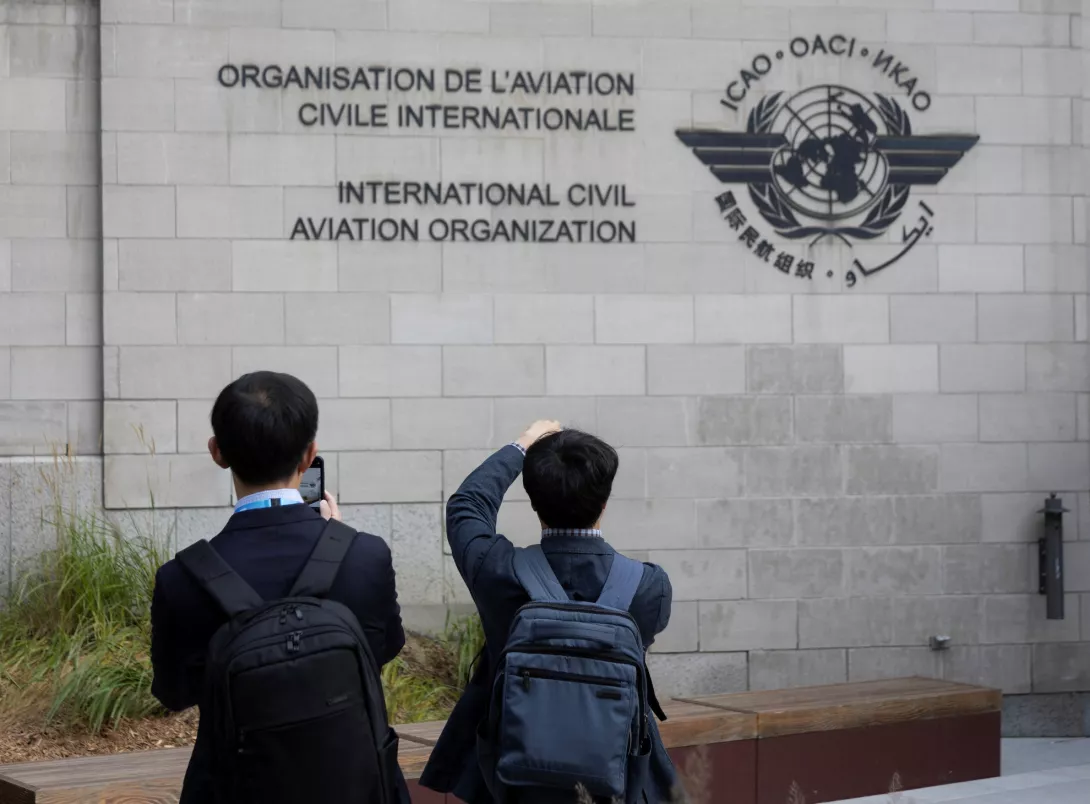
Pressuring three countries is not the first time that Beijing has exerted pressure in the aviation space against Taiwan. When Tsai Ing-wen was first elected president in 2016, Beijing began blocking Taiwan's participation as a guest observer at the International Civil Aviation Organization (ICAO), the United Nations agency responsible for aviation-related issues. Since 2016, Beijing has blocked Taipei's participation in ICAO's triennial assembly. That initial veto, and the UN agency's acceptance of the People's Republic of China's reinterpretation of Taiwan's international status, was an early indicator that Beijing would be weaponizing global institutions against Taiwan.
At the time, an ICAO employee said, "ICAO follows the United Nations' 'One China' policy." While many of its members have a "One China" policy, the UN and its agencies do not. Beijing has successfully managed to convince the UN system to reinterpret the meaning of UN Resolution 2758 to exclude Taiwan from such participation by arguing that it clearly sets out the UN's policy and standards on Taiwan.
During the Ma Ying-jeou administration, Beijing allowed Taipei to participate in such meetings. In 2013, Beijing even asked ICAO to invite Taipei to that meeting. The reason for the change in behavior is simple: Tsai did not accept the 1992 Consensus, a requirement by Beijing for cross-strait engagement. Back in 2016, PRC Foreign Ministry spokesperson Lu Kang explicitly connected the two: "The prerequisite for Taiwan to participate in any international activity is for it to agree to the 'One China' policy and for this to be resolved through consultation." During her two terms in office, Tsai never backed down and accepted the PRC position, so Beijing blocked Taipei's participation from every sort of UN institutional meeting and used that position to expand into other international groups like Interpol.
By blocking Taiwan's participation at ICAO, Beijing prevented Taipei from raising concerns in the globally recognized and accepted forum for discussing problems with airspace and flight routes. This exclusion became important when China began to interfere in the civilian air domain, or when the People's Liberation Army announced no-fly zones over Taiwanese civilian flight routes to conduct a military exercise to punish Taipei for the 2022 visit by then-U.S. House Speaker Nancy Pelosi.
Air Traffic Control in the Taiwan Strait
Beijing followed a similar approach in its civilian aviation space. In 2015, the Civil Aviation Administration of China (CAAC) announced the creation of a new flight route, M503, in the Taiwan Strait. Beijing and Taipei were able to negotiate changes to the route, including moving the route westward, further away from the middle of the Taiwan Strait, and using the route only for southbound traffic. However, these negotiations took place during the Ma administration. Beijing shut off all formal cross-Strait communication in response to Tsai's inauguration, and with that came the end of such negotiations.
Fast forward to 2018: Beijing had successfully blocked Taipei from ICAO and thus limited its ability to lodge complaints about issues such as the unilateral opening of new civilian flight routes that overlap with other routes. In January, the CAAC announced that it would open the M503 route to northbound flights and begin operating routes W121, W122, and W123, which connected to M503 on an east-west route. However, these routes would only utilize the westward direction. The routes were announced and opened on the same day, giving Taipei and carriers no time to adjust. In response, the Tsai administration did not approve the expansion of cross-Strait flights during the Lunar New Year holiday.
Then, in response to the election of Lai in 2024, Beijing announced that it would fully utilize all of these flight routes. The CAAC ended the Ma-era compromise by moving M503 six nautical miles eastward, closer to the Taiwan Strait. That route is now only four miles from the middle of the Taiwan Strait. It also opened the other routes to eastbound flights. That decision created a situation in which more aircraft would be flying from China toward Taiwan, increasing uncertainty and limiting the amount of time for decisionmakers to respond if a cluster of planes continued to Taiwan's side of the Taiwan Strait. It also complicated Taiwan's flights to Kinmen, which is very close to the W123 route, and Matsu, which is close to W122.
Granted, since 2016, no major reported incidents have occurred as a result of the expansion of these routes. However, the way in which Beijing created these flight routes is indicative of how it has approached the Tsai and Lai presidencies: with disregard for international norms and coercion to demonstrate its power vis-à-vis Taiwan.
Coercion Coin Flip
With the recent incident involving Madagascar, Seychelles, and Mauritius forbidding Lai from using their airspace, and Germany and Czechia refusing to allow Lai to land in their countries, Beijing has globalized its coercion in civilian airspace. Beijing has disregarded global norms and rewritten the rules for how countries can utilize their airspace for civilian use.
In Africa, Beijing compelled the countries into taking a low-cost action against Taiwan. In Europe, Germany and Czechia self-deterred out of fear of reprisal, or due to Beijing's long history of punishing countries for their engagement with Taiwan compelled them into making this decision.
In these scenarios, Beijing did not deter Taiwan from carrying out an action to maintain the status quo. Instead, Beijing changed the current cross-Strait dynamics through compellence. Utilizing compellence toward third parties has become a hallmark PRC tactic to change the cross-Strait status quo. Typically, coercion theory is applied in the military sphere, but the Chinese Communist Party has exported compellence and deterrence into other spaces, such as civilian airspace. Beijing now utilizes a coercion toolkit spanning the diplomatic, informational, military, economic, legal, societal domains and beyond.
In this example, the goal is to prevent a Democratic Progressive Party president from visiting foreign countries to conduct informal or state-to-state relations. While Lai was able to successfully get to Eswatini by flying in the king's plane, this was a precedent-setting example that can be duplicated, expanded, and evolved the next time. It is no longer far-fetched to imagine a situation in which King Mswati or another foreign leader announces a visit to Taipei and Beijing blocks the trip by implementing no-fly zones all around Taiwan to ensure flight safety during a military exercise. Beijing typically starts small before expanding its reach so that the slow coercive squeeze is less noticed and the status quo has already changed before the next larger action is taken.
Opening the Skies
The next time that Lai publicly announces an international trip, Beijing will certainly work to prevent his air travel. Visiting a landlocked country like Paraguay, whose president just completed a visit to Taiwan, could become difficult. Compelling countries to close their airspace to Taiwan's president could force Lai to keep all international visits secret until his arrival.
This "arrive then announce" approach has its limitations and, depending on the trip, creates risks of leaks. This particular approach is also generally used only for leaders visiting unsafe areas like war zones. Using this approach for every visit would delegitimize Taiwan's ability to conduct regular international relations by treating everything so covertly. Using the planes of the leaders of the receiving countries is a viable alternative, as it is less likely that Seychelles would block a Swazi plane from flying through its airspace.
Given Taiwan's location, it relies on overflight permission from many countries for any westbound flight. Flying eastbound is relatively easier, as the overlap includes only Japan and the United States. Beyond the airspace issue, Tokyo and Washington already have key roles in deterring China from changing the regional status quo. The U.S. Congress could pass legislation, or amend the TAIPEI Act, punishing nations that acquiesce to Chinese coercion in this regard; however, the Trump administration, which itself engaged in these practices, would have to enforce such a law to stop this type of action from spreading. Congress could also pass legislation making it U.S. policy that the president of Taiwan is allowed to land inside the United States—without the pretext of a refueling stopover—with the same privileges as other leaders. Such legislation would formalize what Beijing likely already believes to be the case.
It is only a matter of time before Beijing enacts another form of coercion against Taiwan. The Eswatini saga will likely be overshadowed by subsequent international events, such as the Trump-Xi summit in Beijing or the G7 Summit. However, it is important that like-minded democratic nations do not forget what transpired in April 2026. It is not just up to Taiwan to make sure that this coercion in civilian airspace does not expand to other parts of the globe. This time, Taiwan was blocked, but as authoritarian nations test and trade coercive tactics, it could happen to another country.