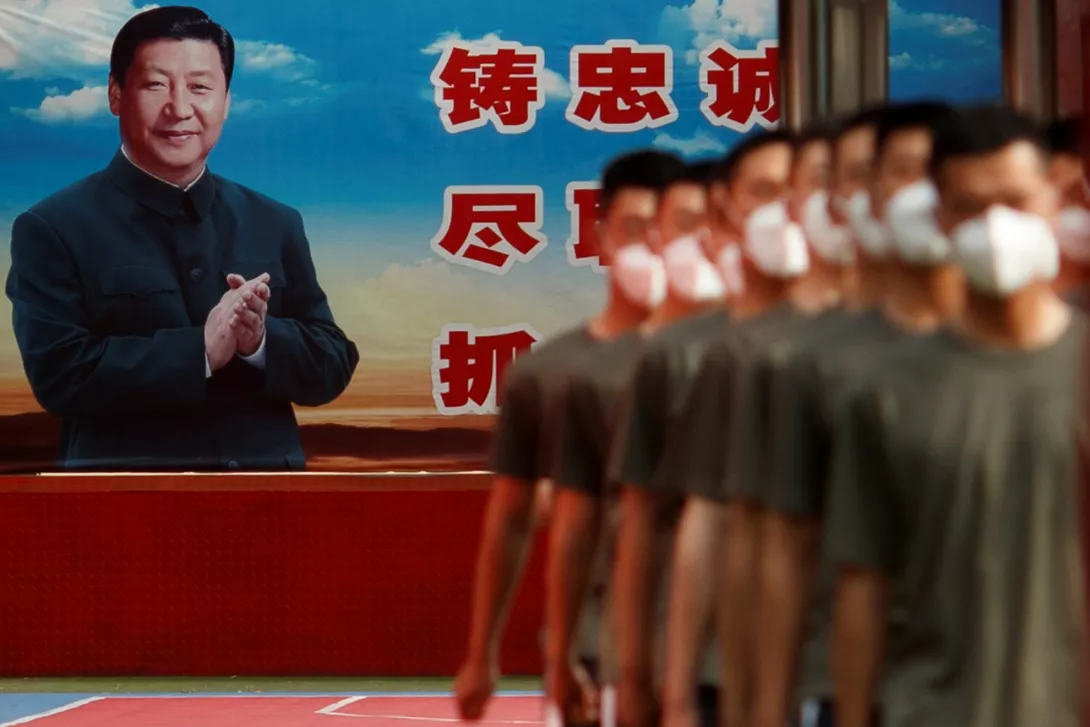
- China's high reported levels of public trust may mask more conditional, fragmented, and unstable forms of political support.
- Deeply embedded institutional constraints limit China's ability to sustain economic reform, contributing to structural slowdown.
- For Taiwan, China's internal fragility does not equate to reduced risk, but may instead heighten uncertainty and external assertiveness.
In comparison to the growing fragility and divisiveness of political systems elsewhere, including in the United States, the Chinese regime appears to the outside world as competent and stable—an image that Beijing is eager to project.
Two new books challenge this view. In Political Trust in China, the political scientist Lianjiang Li digs deep into survey methodology to question the way that most scholars have measured public support for leaders in Beijing. He concludes that citizens' trust in the regime is weaker than other researchers believe. In Institutional Genes, the economist Chenggang Xu uses a sweeping comparative and historical analysis of China's political institutions to argue that the country's inability to reform them will condemn it to economic stagnation. In Xu's view, the kind of authoritarian rule that worked for China's imperial dynasties is strangling its modern economy.
For many years, predicting the downfall of the Chinese Communist Party was something of a sport among China watchers. But few serious observers today suggest that China looks unstable. Despite facing numerous challenges, including the implosion of the country's real estate sector since 2021 and high debt loads that have bogged down local government finances, China's political system appears strong. Chinese leader Xi Jinping has a firm hold on all the levers of power, and the country is proving to be competitive, or even dominant, in a growing number of twenty-first-century technologies, such as electric vehicles and biotechnology. Moreover, scholars consistently find overwhelmingly high levels of public support for the regime.
Survey Says
Li, a professor at the University of Hong Kong, is a veteran scholar who has spent decades trying to understand and measure the foundations of political and social trust in China through field surveys of Chinese citizens. A well-designed survey with a valid sample of respondents produces a map of attitudes and behaviors within a population. Investigating variation within this map allows a social scientist to analyze how different types of citizens think and act, for example, how characteristics such as education, gender, and income shape what people believe and how they behave. But Li, like all good survey researchers, is uncomfortable with some of the core assumptions of the method he uses.
Gathering large quantities of survey data requires simplifying complex attitudes: citizens answering questionnaires have to express unidimensional views on multidimensional topics. The dangers of overly simplified results are especially pronounced when scholars try to understand how citizens view the state. Researchers often ask respondents to rate their level of trust in various public institutions, such as the national government, local officials, or the police, on a scale from one to six or one to ten. Scholars frequently use the average trust level in these institutions as a variable, labeled "institutional trust," to summarize a regime's legitimacy in the eyes of its citizens.
Li argues that the high level of reported institutional trust in China is misleading. In China, people trust the government because they "do not have an enforceable right to retract trust through free, fair, and regular elections," that is, because they have no alternative. It is akin to what political theorists describe as adaptive preference formation: individuals form preferences within the limits of what is realistically available to them. Li calls this phenomenon "embedding," because the range of possible preferences is embedded in the system in which those preferences are formed. Embedded trust is still real trust, but it is fundamentally different from the trust expressed in systems where citizens have the option to withdraw support.
Li thus set out to find a more meaningful measure of regime support than the conventional measure of embedded trust. He narrows his focus from trust in a set of core government institutions to trust in the top power holders in the party center, in practice, has become synonymous with Xi Jinping. He further reconceptualizes trust not as a single rating, but as a set of types based on two dimensions: commitment and capacity. Commitment refers to citizens' belief in the leadership's willingness to pursue sound policy goals, while capacity reflects belief in the leadership's ability to ensure that the bureaucracy can carry them out.
This approach generates four types of trust in contemporary China. Citizens expressing total trust have confidence in both commitment and capacity. Those with partial trust believe in the leadership's commitment but not its capacity. Those who are skeptical harbor doubts about one or both dimensions, while those expressing total distrust have faith in neither. This typology offers a more granular understanding of political attitudes than conventional aggregate measures.
Li's findings suggest that only a minority of citizens fall into the category of total trust. A substantial portion of the population expresses partial trust or skepticism, and a nontrivial share expresses outright distrust. Even if such estimates should be interpreted with caution, they challenge the widely held assumption that China's population overwhelmingly supports the regime.
This more differentiated perspective also helps explain patterns of political behavior in contemporary China. Those with total trust tend to support the government, while those who are skeptical are often politically apathetic. Individuals with partial trust, who believe in the leadership's intentions but doubt its implementation capacity, are more likely to channel grievances toward local authorities through petitions, complaints, or online platforms. Those with total distrust are more inclined to engage in protest or other forms of overt dissent.
Li's analysis suggests that dissent may pose a greater potential threat to the regime than is often assumed. If a significant number of citizens expressing distrust were to mobilize, perhaps triggered by an economic downturn or public health crisis, those with partial trust could join them, followed by those who are skeptical. Under such conditions, protest could spread across social groups, eroding the perception of regime invulnerability that underpins political stability.
Genetic Disorder
Whereas Li challenges overly optimistic views of regime support, Xu questions similarly optimistic assessments of China's economic trajectory. Although official figures place growth at around five percent, Xu has argued that actual growth may be far lower, possibly even approaching stagnation.
In Xu's analysis, China's economic challenges are rooted not in cyclical fluctuations but in the structure of its political institutions. Sustained economic growth requires the state to relinquish some degree of control. In the decades following Mao Zedong's death, China did allow limited liberalization, permitting private enterprise, local experimentation, and greater autonomy in certain sectors. This partial opening enabled the rapid expansion that defined China's economic rise.
However, Xu contends that the underlying Leninist party-state system is fundamentally incompatible with sustained autonomy. As private entrepreneurs, intellectuals, and the middle class gained influence, tensions emerged between economic dynamism and political control. In recent years, the leadership has moved decisively to resolve these tensions in favor of control.
Policies under Xi have included increased regulation of private firms, expanded party presence within enterprises, tighter control over media and information, and enhanced systems of social surveillance. While these measures reinforce political authority, they also constrain innovation and reduce the flexibility that previously supported economic growth.
Xu introduces the concept of "institutional genes" to explain this pattern. These refer to deeply embedded features of China's governance system, including centralized authority over resources, hierarchical administrative structures, and mechanisms for ideological control. Such features, rooted in imperial governance, have persisted across historical periods and continue to shape contemporary institutions.
From this perspective, China's earlier period of reform and opening was inherently limited. The institutional framework could accommodate temporary adjustments but not sustained transformation. The recent reassertion of control is therefore not simply a matter of leadership preference, but an expression of deeper structural constraints.
Xu argues that these constraints make meaningful reform difficult, if not impossible, within the existing system. Economic liberalization generates pressures that ultimately conflict with the political logic of centralized control. As a result, periods of openness are likely to be followed by retrenchment, limiting long-term growth prospects.
Cracks in the Foundation
Both Li's and Xu's analyses point to a system whose stability is more contingent than it appears. Political trust is closely tied to perceptions of leadership credibility, while economic performance remains a key source of legitimacy. Institutional rigidity constrains the system's ability to adapt to new challenges.
At the same time, the regime retains significant strengths, including organizational capacity, control over information, and the ability to suppress dissent. Fragility, in this context, does not imply imminent collapse. Rather, it suggests that the system may be vulnerable to shocks that undermine confidence in leadership or disrupt existing patterns of control.
Such shocks could take various forms, including economic crises, public health emergencies, or geopolitical conflicts. If these events were to weaken perceptions of leadership credibility, they could trigger shifts in public attitudes, particularly among those who already harbor doubts about the system’s capacity. In such scenarios, dissent could spread in ways that are difficult to predict.
Importantly, the absence of strong institutional alternatives reduces the likelihood that any crisis would lead to a stable democratic transition. Without well-developed legal frameworks, civil society organizations, or norms of constitutional governance, a breakdown of the current system would more likely result in another form of authoritarian rule.
Although many might hope that China's fragility would distract Beijing from putting pressure on Taiwan, the implications of these books should serve as a warning. Lacking either the trust or the institutional genes to set up a more stable alternative, a post-authoritarian regime rooted more in raw power than in engineered consensus might be even harder for Taiwan to deal with than the relatively disciplined and strategic regime China has today.
This article was originally published in the March/April issue of Foreign Affairs, pp. 152–158, under the title "China's Fragile Future: How Secure Is the CCP?" It is republished in "Thinking Taiwan" following some revisions and additions by the author.