- "A Taiwan contingency is a Japanese contingency" is not a fixed strategic conclusion, but a dynamic political process shaped by battlefield developments, U.S. decisions, Japanese public opinion, and cabinet-level judgment.
- Japan and the United States are deeply interdependent in security cooperation. In practice, Japan would find it difficult to make decisions independently from U.S. military assessments, the use of U.S. forces stationed in Japan, and alliance coordination.
- Taiwan's security planning cannot rest on romanticized assumptions about Japanese goodwill. It must instead be grounded in a sober understanding of uncertainty.
In recent years, Japan has spoken with increasing clarity regarding security in the Taiwan Strait. From former Prime Minister Shinzo Abe's statement that "a Taiwan contingency is a Japanese contingency" to Prime Minister Sanae Takaichi's parliamentary remarks that a Chinese attack on Taiwan could constitute a "situation threatening Japan's survival," Japan's rhetoric on Taiwan Strait security has become more explicit than in the past. At the same time, Japan has pursued defense reforms, strengthened multinational security cooperation, and loosened restrictions on defense equipment exports. Taken together, these developments suggest that Japan's position on a "Taiwan contingency" appears to be moving gradually from political rhetoric toward policy implementation.
It is important to recognize, however, that amid rising Sino-Japanese tensions and increasingly close Taiwan-Japan societal exchanges, Taiwanese society seems to have developed a psychological expectation that Japan would inevitably "take action" in the event of a cross-strait conflict. The signals released by the Japanese government certainly carry political significance. Yet interpreting such signals as institutional commitments may oversimplify the realities of Japan's decision-making structure under its legal system and alliance framework. To understand this issue more deeply, one must first recognize a fundamental premise: whether Japan intervenes—and in what form—is not simply a matter of strategic choice. It remains tightly constrained by existing institutions and legal frameworks.
Japan's Three Layers of Military Restrictions: Situation Recognition Is Key
After World War II, Japan established extremely high thresholds for the use of military force. Broadly speaking, this institutional design can be understood as a three-layer structure. The first layer is Article 9 of the Japanese Constitution and its top-level principle of "renouncing war," which establishes non-use of force as the basic premise. The second layer is the "Three Conditions for the Use of Force ," which constrain any military action to measures of "necessary and minimal self-defense." The third layer is "situation recognition," under which the cabinet determines the nature of the current crisis and accordingly decides what actions may legally be taken.
This legal framework underwent a major turning point in 2015, when the Abe administration advanced the Security Legislation reforms by reinterpreting the Constitution and redefining what circumstances qualified as "self-defense." Before 2015, Japan's use of force was strictly limited to cases in which Japan itself was under attack. After the reforms, Japan could also use force if another country were attacked and the situation threatened Japan's survival, provided the Three Conditions for the Use of Force were satisfied. In other words, Japan did not gain unrestricted freedom to wage war; rather, exceptions were added within the preexisting framework of military restraint.
Under the current system, therefore, Japan's logic for using military force is not simply triggered by the outbreak of war. The government must first determine what kind of "situation" exists—for example, whether it constitutes an "armed attack situation," a "survival-threatening situation," or an "important influence situation." Different classifications correspond to different levels of intervention.
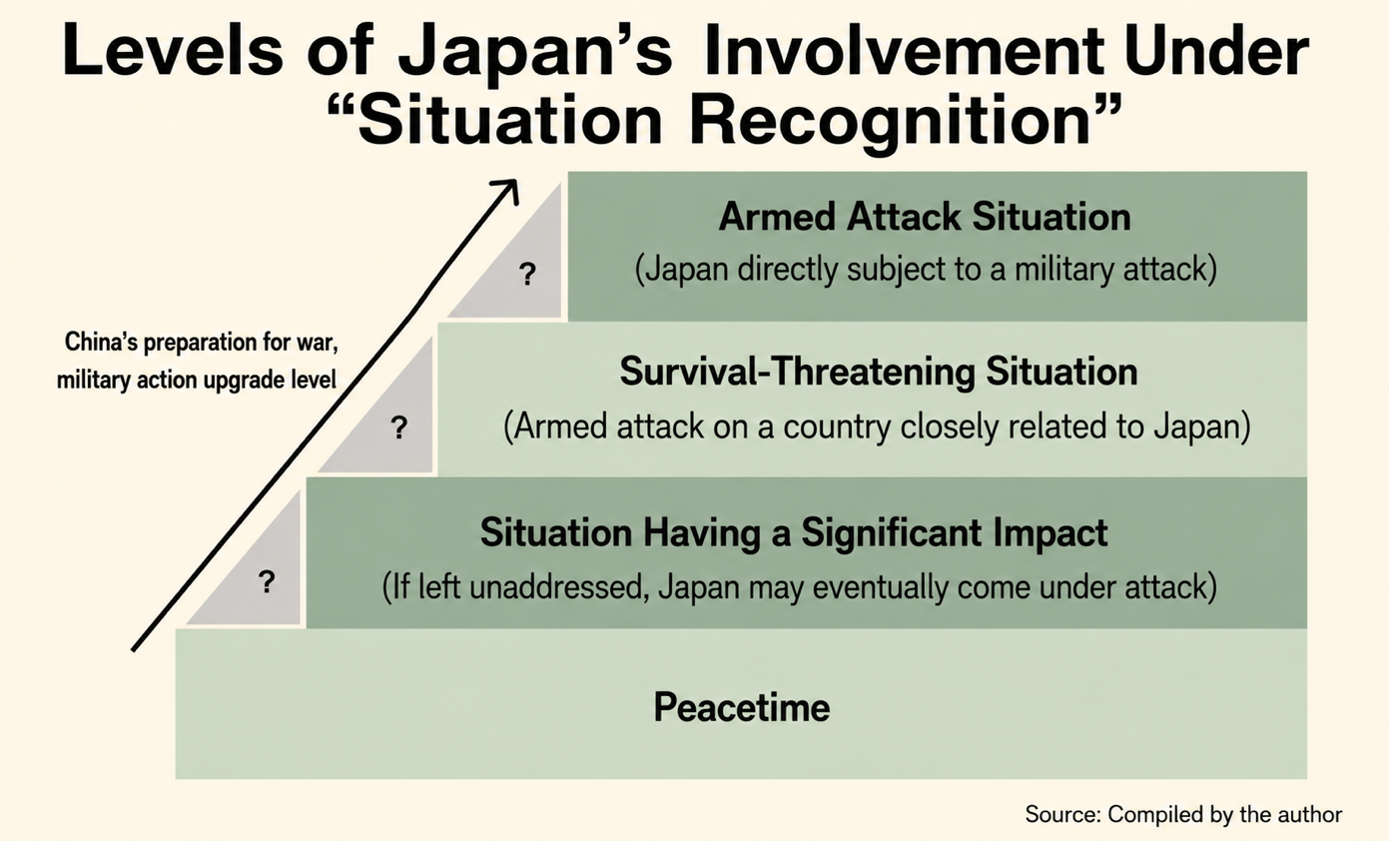
In other words, even if Japanese politicians frequently make statements about Taiwan, a "Taiwan contingency" does not automatically trigger "Japanese participation in war." It must first pass through a series of legal judgments: whether the situation constitutes a "survival-threatening situation," and whether it satisfies the Three Conditions for the Use of Force. This means Japanese intervention would involve not only political and temporal costs, but also highly sensitive diplomatic judgments.
In fact, after Prime Minister Takaichi's controversial November 2025 parliamentary remarks linking a "Taiwan contingency" to a "survival-threatening situation," she was questioned again on the issue in parliament the following month. This time, she responded cautiously and closely adhered to prepared briefing materials, even acknowledging that her earlier remarks had been interpreted as going beyond the government's established position and required reflection. This shift reflected her efforts to lower the intensity of her rhetoric after facing diplomatic and parliamentary pressure. It therefore warrants a reassessment of whether Japan is truly moving toward strategic clarity.
At the same time, Japan's current legal framework contains another sensitive issue. If Japan invokes the legal rationale that "another country being attacked threatens Japan's survival," the Japanese government would inevitably have to confront the question of whether Taiwan qualifies as "another country." This would almost certainly provoke strong reactions from Beijing and further complicate the decision-making process.
Under the Alliance Structure, U.S.-Japan Decisions on Taiwan Are Deeply Interconnected
In addition to Japan's internal legal system, another critical external factor shaping Japan's role in a Taiwan contingency is the U.S.-Japan alliance and broader security cooperation.
For Japan, Taiwan occupies a central position in the first island chain. Taiwan's status affects not only the security of maritime trade routes, but also Japan's own strategic environment. So long as Taiwan remains a democratic polity, it provides Japan with an important security buffer. Taiwan's strategic value is therefore undeniable. Looking back to the Cold War era, crises on the Korean Peninsula and in the Taiwan Strait both had the potential to alter Japan's national development trajectory. Yet Japan was able to prioritize economic development over military investment after the war precisely because it relied on the security system centered around the U.S.-Japan Security Treaty.
Even today, despite shifts in America's global strategic posture and Japan's significant strengthening of its own defense capabilities, coordinating responses with the United States during major security crises remains the politically and institutionally least costly path for Japan. Conversely, Japan also remains one of the United States' most important strategic platforms in Asia, creating a highly interdependent security relationship between the two allies.
Within this structure, Japan's decision on whether to intervene in a Taiwan contingency can hardly be viewed as a completely independent variable. In practice, Japan would find it difficult to separate its decision-making from U.S. military assessments, the use of U.S. forces stationed in Japan, and alliance coordination. Put differently, while U.S. and Japanese intervention may appear to be two separate variables, they are in reality deeply interconnected.
More importantly, even if Japan has limited willingness to intervene directly, once the United States decides to intervene militarily, Japan would find it difficult to remain completely uninvolved because of alliance operations, the activities of U.S. forces stationed in Japan, and logistical support obligations. Thus, while Japan's legal framework may constrain whether it can proactively and directly intervene, the U.S.-Japan alliance significantly shapes whether Japan could nonetheless become entangled in the conflict.
Gray-Zone Operations and Public Opinion Add Further Uncertainty to Japan's Decisions
Against the backdrop of worsening security conditions, Japan has accelerated adjustments to its defense strategy in recent years. In its National Security Strategy documents, Japan has explicitly heightened its perception of the China threat while also strengthening alliance command-and-control coordination with the United States, reorganizing the Self-Defense Forces, reinforcing deployments in the southwestern islands, developing counterstrike capabilities, and restructuring its defense industry. Overall, Japan is responding more actively to the security risks associated with a Taiwan contingency through a broad series of policy adjustments.
Yet the real question is not whether Japan is strengthening its military capabilities, but rather what form a Taiwan contingency would take.
As the balance of power between China and the United States evolves alongside technological developments, Chinese military action against Taiwan may not take the form of a conventional war. Instead, it could involve gray-zone operations, coercive encirclement short of attack, or limited military actions. The case of Chinese hacker groups targeting infrastructure in Guam—actions believed to potentially affect electricity supplies to U.S. naval facilities—illustrates how such operations may prepare the groundwork for a future attack on Taiwan without constituting a traditional armed attack. If China were to employ similar tactics against Taiwan or Japan, it would become even more difficult to determine whether the threshold for war had actually been crossed. Under such highly uncertain battlefield conditions, the key question becomes how Japan's legal framework and the U.S.-Japan alliance structure would respond to crises of varying intensity and form.
Another major source of uncertainty lies in Japanese domestic politics and public opinion. After Prime Minister Takaichi’s remarks regarding a Taiwan contingency, Japanese society did not display a unified response. A Kyodo News poll conducted on November 15–16, 2025, found that 48.8 percent supported exercising the right of self-defense in the event of a Taiwan contingency, while 44.2 percent opposed it. By contrast, an ANN poll conducted during the same period found that only 33 percent supported the use of force under collective self-defense, while 48 percent believed it unnecessary. The significant discrepancy between the two surveys suggests that Japanese public opinion has not reached a stable consensus.
These differences may stem from multiple factors. First, Prime Minister Takaichi enjoyed relatively high approval ratings early in her tenure, leading some respondents to support related security policies because they broadly approved of her political direction. Second, Japanese citizens vary considerably in their understanding of battlefield scenarios and the legal meaning of collective self-defense, while differences in survey wording may also influence responses. Third, such polls are typically conducted after major incidents rather than as long-term tracking surveys, and public opinion can fluctuate rapidly depending on political developments and phrasing. Overall, Japanese society's attitude toward intervention in a Taiwan Strait conflict remains highly fluid.
Japan today is indeed at a critical turning point in its security policy transformation. Strengthened defense deployments and increasingly explicit political rhetoric can easily create the impression that Japan would inevitably intervene actively in a Taiwan contingency. Yet it must be remembered that Japan has still not fully transformed into a "normal state" capable of freely using military force. Its legal and institutional constraints remain significant, while public opinion remains highly volatile. In other words, "a Taiwan contingency is a Japanese contingency" is not a question with a clear and predetermined answer, but rather a dynamic process highly dependent on unfolding circumstances, political judgment, and institutional operations.
Taiwanese Expectations Toward Japan Exceed Those Toward the United States—A Strategic Miscalculation Must Be Avoided
From the perspective of geopolitics, Japan's recent defense reforms, and the structure of the U.S.-Japan alliance, the phrase "a Taiwan contingency is a Japanese contingency" is not an empty slogan. Yet neither should it be treated as an inevitable strategic law. Taiwanese society in particular must remain clear-eyed about this reality.
According to a March 2022 survey by the Taiwan Public Opinion Foundation, 43.1 percent of Taiwanese respondents believed Japan would help defend Taiwan, compared to 34.5 percent who believed the United States would do so. Although more than four years have passed since the survey, it remains highly revealing: Japan was viewed as more likely to defend Taiwan than the United States, long regarded as Taiwan's primary security backer. At the time, the Russia-Ukraine war had already begun, and Taiwanese perceptions of direct U.S. intervention had been shaped by the reality that Western countries supported Ukraine indirectly without entering the war directly. In contrast, Taiwanese expectations regarding possible Japanese intervention have not undergone a similar reality check.
Taiwanese trust in Japan likely stems from positive sentiment, geographic proximity, and a shared sense of threat from China, rather than a detailed understanding of Japan's Peace Constitution, security legislation, or rules governing the Self-Defense Forces. Mistaking such emotional trust for a concrete security commitment could easily lead to unrealistic strategic miscalculations.
Accordingly, the issue that requires deeper evaluation is not merely whether Japan would intervene, but whether Japan could complete the necessary legal determinations, political judgments, and alliance coordination within a short timeframe. Moreover, Japanese involvement should not be viewed as a simple binary question. Intervention might not initially take the form of direct military participation, but rather intelligence sharing, sanctions against China, aid to Taiwan, or the acceptance of refugees. Only under more escalatory circumstances might the use of force become possible.
Ultimately, when considering whether "a Taiwan contingency" means "a Japanese contingency," we must recognize that this is not a fixed legal conclusion. Rather, it is a political process that evolves dynamically according to battlefield conditions, U.S. decisions, Japanese public opinion, and cabinet-level judgments. Taiwan's security planning cannot be based on romanticized assumptions about Japanese goodwill. It must instead rest on a sober understanding of uncertainty.