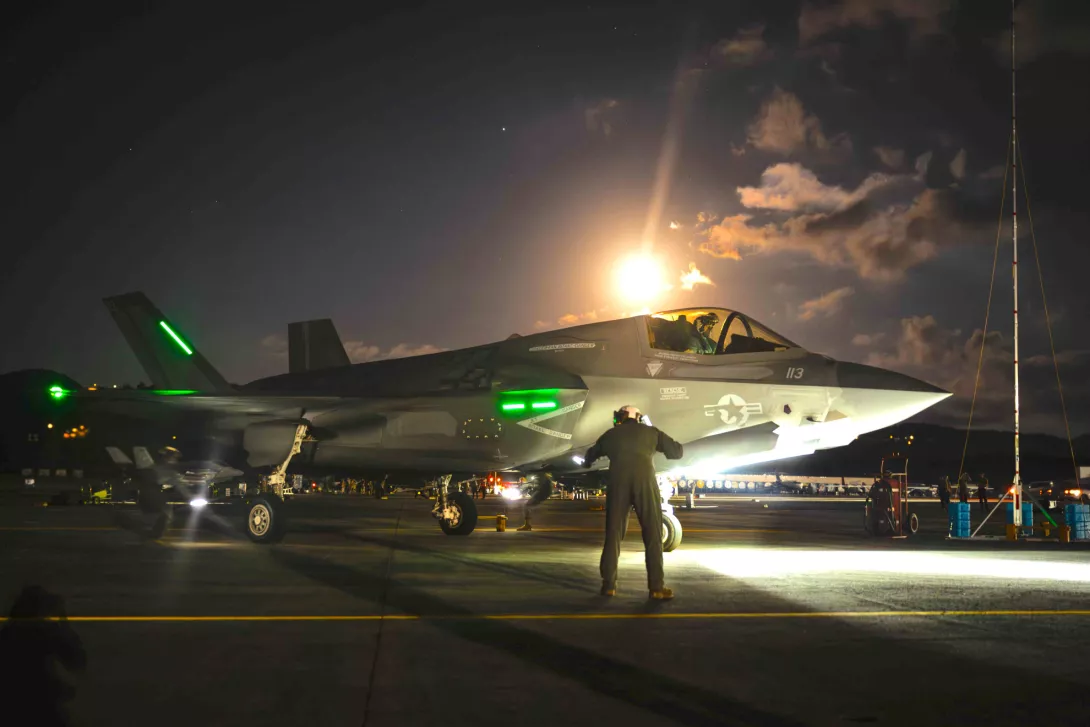
- U.S. operations in Iran and Venezuela demonstrate advanced multi-domain systems integration and should command close attention in Beijing.
- In areas such as multi-domain integration, the United States and its allies retain clear qualitative advantages; by contrast, despite its impressive scale, the PLA continues to face structural gaps.
- China's military capabilities should neither be underestimated nor overstated. Sustained investment in self-defense and the strengthening of collective defense networks remain central to effective deterrence.
On a recent day, the U.S. military carried out "Operation Absolute Resolve", a tightly coordinated operation that unfolded largely out of public view but spoke volumes about the character of modern American military power. Without mass troop movements or public declarations, the operation integrated real-time intelligence, cyber and electronic warfare, stealth aircraft, unmanned systems, and special operations forces into a precise, time-compressed sequence. Within hours, key objectives were met and forces withdrawn, underscoring a form of military strength defined less by scale than by precision, integration, and execution.
The operation offers a revealing counterpoint to widespread assumptions that China's rapidly expanding military inventory automatically translates into comparable war-fighting capability. As this article argues, numbers alone are a poor proxy for combat effectiveness. High-end conflict increasingly turns on joint execution, multi-domain coordination, and operational maturity—areas in which the United States and its allies retain decisive qualitative advantages, and where the People's Liberation Army (PLA), despite its impressive growth in size, continues to face significant structural gaps.
China's Military Expansion: Unprecedented in Scale and Speed
During the past two decades, the threat from China has expanded from areas immediately surrounding Taiwan to encompass the entire Western Pacific, including the Yellow Sea near Korea, the East Sea adjacent to Japan, the Taiwan Strait, and the West Philippine Sea/South China Sea near the Philippines. The Chinese Navy has conducted multiple shows of force well beyond its immediate periphery, including live-fire exercises near Australia and a circumnavigation of the Australian continent. The scale and pace of military expansion undertaken under Xi Jinping are unprecedented in modern history, rivaling the most aggressive German rearmament efforts seen prior to World War II.
Is China's military expansion a threat? In strategic terms, a "threat" is defined by the combination of capability and intention. The United States, for example, possesses overwhelming military capability, yet it does not constitute a threat to Mexico because it has no intention of attacking it. China, by contrast, has explicitly stated its intention to annex Taiwan and to enforce its illegal claims over nearly the entire South China Sea. Under these conditions, China's military expansion clearly constitutes a direct threat to regional security.
China itself faces no external military threat. No country has articulated an intention to attack China. Why, then, has Beijing pursued such a massive expansion of military power? The most logical conclusion is that China intends to use this force against others to achieve its political objectives. The threat from China is real. The central question is how this growing threat affects Asia-Pacific regional security, and whether the United States and its allies possess the capability to deter conflict or respond effectively to Chinese aggression.
China's economic success has provided the resources necessary to sustain long-term military expansion and to impose its will through intimidation, not only within the Asia-Pacific region but beyond it. As its military power has grown, China has updated its military strategy accordingly. The U.S. Department of Defense's 2025 China Military Power Report notes that China's revised strategy reflects increasing confidence and comfort with military escalation, including escalation involving the United States. This assessment should be deeply concerning to regional actors, as it signals a potential erosion of deterrence.
This dynamic helps explain why President Trump's revised U.S. National Security Strategy emphasized alliance building in the Indo-Pacific. It also sheds light on congressional actions, including provisions in the 2026 National Defense Authorization Act that fund alliance strengthening and the enhancement of allied and partner military capabilities.
Why Size Alone Overstates the PLA's Combat Power
China's military growth has been particularly striking in quantitative terms. In 2011, China operated no aircraft carriers; by 2025, it fielded three operational carriers, with a fourth under construction. In 2015, China possessed approximately 2,100 combat aircraft across the PLA Air Force and Navy; today, that number stands at roughly 3,300. Over the same period, China's naval fleet expanded from about 255 warships to approximately 395.
In recent years, China has added roughly 30 large naval vessels per year and retains the capacity to increase production further. In the air domain, China is producing more than 240 combat aircraft annually. Similar growth trends are evident within the PLA Army and Rocket Force.
These figures are undeniably alarming. They do not, however, automatically translate into overwhelming war-fighting capability. While quantity carries strategic weight, assessments based primarily on platform counts risk overstating actual combat effectiveness.
Combat capability is not determined by hardware alone. Performance under real-world conditions, system reliability, and long-term supportability all matter. Equally important are the training, experience, and proficiency of the personnel who operate these systems.
A fighter aircraft, for example, is not a complete weapon system without a skilled and experienced pilot. Even then, effective employment requires sound operational concepts and advanced tactics. Commanders must understand when and how to employ airpower, and pilots must know how to engage adversary aircraft based on relative performance characteristics. In areas such as employment strategy, tactical sophistication, combat experience, training realism, and weapons reliability and sustainment, China continues to exhibit notable weaknesses. These shortcomings are likely to constitute the PLA's "Achilles' heel" in high-intensity conflict.
For these reasons, regional actors should avoid being intimidated solely by the scale of China's growing force structure. At the same time, Taiwan and other countries threatened by China must continue to invest in their own defense capabilities. The United States will likewise continue to share operational experience and lessons learned with allies and partners.
Collective Defense Is Essential to Deterring China
To counter China effectively, like-minded countries in the region must engage in collective defense and train together to develop joint employment concepts and tactics. Leveraging collective strength remains essential to deterring China and, if deterrence fails, defeating Chinese aggression.
One aspect of China's military growth that warrants particular concern is its expanding nuclear arsenal and employment doctrine. China's nuclear stockpile has reportedly grown from approximately 300 warheads in 2020 to about 600 in 2025 and is expected to reach 1,000 by 2030.
The dense configuration of China's nuclear missile silos suggests a posture consistent with either a first-strike or launch-on-warning policy, likely coupled with an all-or-nothing employment strategy. Because these silo fields are unlikely to survive a nuclear strike, China would face strong incentives to launch early in a crisis. This posture is inherently dangerous. Preventing nuclear use therefore continues to rely on the long-standing principle of Mutual Assured Destruction.
Deterring Chinese aggression requires corresponding growth in regional defense capabilities to prevent further degradation of deterrence. As noted earlier, this must be collective defense, as no single country in the region can counter China alone.
The United States maintains more than 100,000 troops under Indo-Pacific Command, most of them forward deployed in the Western Pacific. Approximately 28,500 personnel are stationed in Korea, while about 37,000 are based in Japan, the majority in southern Japan near Taiwan.
Guam represents the United States' first line of follow-on forces in the event of conflict in the Western Pacific. Currently hosting around 15,000 U.S. troops, Guam's presence is expected to expand significantly. Hawaii hosts roughly 45,000 troops. Alaska, often overlooked, is also strategically important; forces based there can reach the Western Pacific faster than those from the continental United States. The U.S. maintains more than 26,000 military personnel in Alaska, along with readily deployable next-generation airpower.
Together with allied forces, these units form the initial blocking force. In the event of war, their mission would be to slow China's advance and buy time for follow-on forces from the continental United States, including carrier strike groups from San Diego and airpower from the western United States.
As tensions rise prior to conflict, the United States would seek to form a coalition of like-minded countries to deter and, if necessary, defeat Chinese aggression. Once reinforcements arrive, the conflict would transition from an initial blocking phase to one of dominance and victory. Holding the line in the early stages would be decisive, making collective defense a critical factor.
Venezuela Operation Showcases America's Multi-Domain Military Edge
Another decisive factor is the ability to execute multi-domain warfare—integrated operations across air, sea, land, space, cyber, and the electromagnetic spectrum designed to degrade an adversary’s command and control, situational awareness, and ability to respond.
The United States has recently demonstrated this capability in operations against Iran's nuclear facilities, where U.S. forces operated inside Iran for 90 minutes without encountering opposition. On a smaller scale, operations related to the capture of Venezuela's president encountered only limited resistance. These demonstrations of multi-domain integration should give Beijing pause.
Operations such as Absolute Resolve require extensive planning, including contingencies for unforeseen human or environmental factors. Plans specify precise sequences, timing, and outcomes. Coordinating approximately 150 aircraft—some held in reserve—launching from 20 geographically dispersed locations represents extraordinary complexity. For an operation lasting only two hours, thousands of hours of planning and rehearsal may be required.
Intelligence, particularly real-time intelligence, is central to success. Reconnaissance teams likely infiltrated Venezuela weeks in advance to monitor air defenses and military activity, identify targets, assess readiness, and collect communications data. These inputs became critical enablers of multi-domain attack.
While the Space Force provided uninterrupted communications, overhead intelligence, and weather data, teams on the ground supplied real-time updates on defensive layouts and conditions. This information enabled senior leadership to determine the optimal moment to execute the plan.
Once execution was ordered, the united States used cyber or other advanced weapon rendering systems without backup power ineffective. Electronic warfare aircraft monitored communications and injected confusion into command and control networks.
E/A-18G Growlers from USS Ford likely entered first to jam radars, followed closely by F-35s from the Vermont National Guard trained in suppressing enemy air defenses. F-22 Raptors from Virginia provided air cover. These aircraft launched from Puerto Rico, while diversionary actions elsewhere distracted Venezuelan forces.
Peace Through Strength Remains the Most Stable and Reliable Path
Once airspace was secured, special operations forces from USS Iwo Jima, already airborne, struck the primary objective. Familiar with the compound layout and Maduro's protective vault, they anticipated his movements. As Maduro was captured amid ground-level confusion, reconnaissance teams were extracted. The ground phase lasted approximately 20 minutes.
Operations of this kind demand multi-domain capability and meticulous planning based on actionable intelligence. At present, the United States is likely the only country capable of executing such operations at scale.
During Operation Absolute Resolve, one critical asset was the RQ-170 unmanned reconnaissance aircraft, which monitored the operation from above. AI-assisted unmanned systems are already contributing significantly to military operations and will continue to do so.
Although China showcased numerous unmanned systems during its September 2025 military parade, the United States has already employed man-unmanned teaming (MUM-T) in real-world operations. AI-enabled autonomous systems have assumed many high-risk missions, and these capabilities continue to expand.
These technological advantages, combined with operational experience and concepts refined through real combat, will matter greatly should China choose to use military force as a tool of statecraft.
In sum, China's military capabilities should not be underestimated—but neither should they be overestimated. As the threat grows, sustained investment in self-defense and the development of robust collective defense networks remain essential. Numbers alone do not determine combat capability. Peace through strength remains the most reliable path to lasting stability.