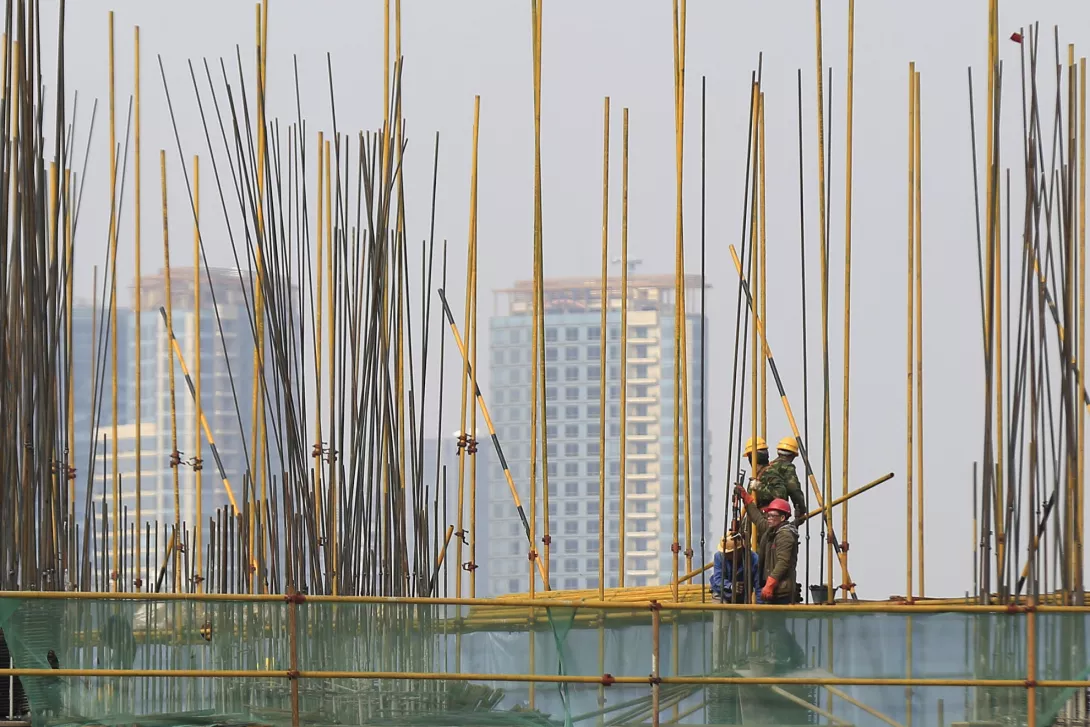
- China's system is distinctive: on the one hand, social dynamism is relatively constrained; on the other, its capacity to suppress, defer, and transform risks may also be relatively strong.
- In 2025, continuing the post-pandemic trend, China's economy remained cold at home and hot abroad. With weak consumption as well as sluggish private and government investment, economic growth heavily relied upon exports.
- Emerging forms of protest reflect that the social contract—under which the Chinese Communist Party traded improvements in living standards for public acceptance of centralized authority—is approaching the point of breakdown.
In recent years, global assessments of the direction of China's political and economic development have increasingly diverged. This has prompted us to consider how to establish a more comprehensive and objective analytical framework for the long-term observation of trends in China's political economy. Over the past year, we convened a series of roundtable discussions with domestic and international scholars and experts specializing in Chinese politics, economics, and society. We also reviewed a wide range of analytical reports from leading global think tanks on China's political and economic development, and combined these perspectives with the research team's long-standing qualitative engagement with China. Through repeated discussion, refinement, and revision, we ultimately decided to structure the framework around five dimensions, economy, finance, fiscal policy, society, and politics, and to develop a total of 50 monitoring indicators for long-term observation. This process culminated in the completion of our first annual report for 2025.
This report draws on an extensive compilation of statistical data related to China's political, economic, and social conditions. Data sources fall into three categories: First are open-source materials released by the Chinese government, including information from the websites of the National Bureau of Statistics, the People's Bank of China, the Ministry of Finance, the Ministry of Commerce, and the National Supervisory Commission, as well as official statistical releases and policy documents. Second are government-affiliated institutions, including the China Government Securities Depository Trust & Clearing Co., the China Foreign Exchange Trade System and National Interbank Funding Center, and the Shanghai and Shenzhen stock exchanges. Third are credible non-governmental research institutions in China and abroad, as well as reporting from news outlets and social media platforms. These data have been systematically collected and compiled by the research team over an extended period. In addition, certain indicators are calculated independently by the team based on established analytical frameworks and theoretical considerations.
This report represents an observation of current conditions and a snapshot of relevant trends at a specific point in time, rather than a definitive or final conclusion. These trends may continue to adjust dynamically in response to changes in domestic and external environments. Moreover, given the distinctive characteristics of China's system, comparisons with other countries require particular caution. On the one hand, bottom-up social dynamics may be more constrained; on the other, the state's capacity to suppress, defer, and transform risks may be relatively strong. When interpreting changes in these indicators, it is therefore essential to remain mindful of China's specific context and to avoid drawing conclusions based on generalized assumptions. We view this report as an exploratory analysis and welcome feedback and critique from all quarters. Such input will help us further refine the monitoring framework, enabling the production of more objective and precise annual reports in the future, to serve as references for diverse audiences and to support dialogue and exchange with think tanks around the world.
Below are the section summaries of the 2025 China Monitoring Report.
Since the collapse of China's real estate sector in 2021, the Chinese economy has been undergoing a dramatic transformation. The property downturn has undermined local governments' land-based fiscal revenues, pushing local public finances and financing vehicles into distress, while private investment and consumption have contracted rapidly. Economic experts have largely converged on the view that China's economic downturn is structural rather than cyclical.
Facing intensifying geopolitical competition abroad, particularly the opportunities and challenges brought by the AI revolution, the Chinese central government has chosen not to directly address weak domestic demand. Instead, it plans to drive economic growth through leaps in productivity in high-technology manufacturing, concentrating resources on upgrading high-tech industries. Observing policy pronouncements from the Third Plenum in July 2024 to the Fourth Plenum in October 2025, there are no signs that China's economic policy direction will change. The emphasis remains on production over consumption, with resources concentrated on supply-side acceleration. As a result, China's economy in 2025 continues the post-pandemic pattern of being 'cold at home, hot abroad.'
Economy: Estimated real economic growth in 2025 is 4.4 percent, rather than the 5% officially announced by China. Investment and consumption remain weak. Although government policy has strongly supported manufacturing upgrading to enhance productivity, the contraction of private investment has led to the first decline in overall fixed-asset investment since 1995. Consumption growth has slowed to 3.7 percent, while the consumer price index (CPI) continues to hover around zero, indicating that the economy has effectively entered deflation. Exports alone are sustaining economic growth. Weak domestic demand, combined with the shift toward supply-chain localization, has reduced imports, pushing China's overall trade surplus to over USD 1.2 trillion for the first time. This has heightened global concern over 'China Shock 2.0' and the export of deflation. At the same time, the withdrawal of foreign capital has produced a new phenomenon in which the share of high-technology products in China's exports has declined, suggesting that the effectiveness of current industrial upgrading policies warrants further observation.
Finance: Amid a simultaneous real estate downturn, weakening local public finances, and private-sector deleveraging, China's economy now exhibits the classic characteristics of a 'balance sheet recession.' Monetary policy has shifted from a growth-stimulating instrument to a defensive mechanism aimed merely at maintaining static financial system stability. In order to preserve a façade of stability, the government has relied on 'Great Wall–style' measures, such as debt swaps and administrative controls, to shift the impact of falling asset prices onto the balance sheets of financial institutions, thereby suppressing the visible manifestation of risk. While this approach avoids an acute crisis, it embeds risk within the system, leading to severe resource misallocation and delaying necessary asset revaluation, ultimately becoming a major source of concern for prolonged low economic growth in the future.
Fiscal Policy: In line with recent trends, the shares of both government revenue and government expenditure in China's GDP have continued to decline. Meanwhile, fiscal deficits and debt issuance have both reached historic highs and are expected to keep rising. When hidden liabilities are included, China's government debt-to-GDP ratio is already comparable to that of the United States; however, given China's relatively weak fiscal revenue base, its future debt-servicing capacity is a cause for concern. As the central government prioritizes geopolitical competition, fiscal policy has sought to relieve budgetary pressure by steadily reducing the proportion of spending related to people's livelihoods and increasing individual tax burdens, producing a 'closing the umbrella when it starts to rain' effect that made things worse at the worst possible time, on the overall economy.
Society: The economic downturn has translated into tangible impacts on people's lives: slower income growth accompanied by rising polarization, increasing unemployment, heavy debt burdens, and declining confidence in economic prospects. Marriage and fertility rates have fallen rapidly, while social security provision has been steadily reduced due to local fiscal crises. Social discontent is rising, manifested in a sustained increase in social protests since the pandemic. Compared with the peak under the Hu Jintao era, however, today's protests are driven less by direct economic losses and more by perceptions of systemic injustice. This suggests that the social contract, accepting centralized power in exchange for improving living standards, has broken down, with some arguing that a 'new class war' has emerged.
Politics: The most salient political trend in 2025 is the renewed intensification of anti-corruption campaigns. Overall, the intensity during the 20th Party Congress period exceeds that of the 18th. Notably, the absence rate of Central Committee members and alternate members at the Fourth Plenum is unprecedented since the start of reform and opening, and is concentrated among senior PLA officers personally promoted by Xi Jinping. Observations of party-wide anti-corruption and disciplinary campaigns likewise show greater intensity than during the 18th Party Congress, indicating an increasingly centralized yet increasingly unstable 'Stalinist logic' under Xi Jinping's leadership.
The official readout of the 'Central Economic Work Conference' held at the end of 2025 still shows no clear indication of a shift away from the imbalanced development path described above. Although Qiushi magazine prominently published Xi Jinping's article, 'Expanding Domestic Demand Is a Strategic Move,' the content largely consists of excerpts from Xi's major speeches since 2015 on expanding domestic demand. This has led markets to perceive that the article's emphasis lies less on 'expanding domestic demand' than on the notion of 'strategy.' As a result, there is a broad expectation that the Chinese government will continue to concentrate resources on accelerating technological self-reliance, using productivity gains to respond to external geopolitical competition and address internal economic challenges.
Calculating from statistical data released by the Chinese government, export composed around 33 % of China's GDP growth in 2025. If the cycle of weak domestic demand, deflation, and deleveraging does not undergo a dramatic shift, China's economic growth is likely to remain heavily dependent on exports. Whether this reliance ultimately expands or constrains China's room for maneuver in its external relations will be an important issue to monitor going forward.(Translated by Ketty W. Chen)